Editorial
The Future’s Looking Bright, We May Need (Prescription) Shades
Keshia S. Elder, OD, MS, MS, FAAO

Keshia Elder, OD, MS, MS, FAAO
Like many other professional programs, the state of the optometry applicant pool continues to be a topic of discussion. From concerns about the quantity, quality and diversity of the pool to the decline in applicants optometry began experiencing 2015-2016,1 ASCO has been acutely aware of the potential for this to become an issue for schools and colleges of optometry. This, coupled with the applicant to matriculant ratio decreasing from 1.53 in 2010 to 1.39 in 2018,2 spurred ASCO into action.
To combat the declining applicant pool, ASCO launched the Optometry Gives Me Life public awareness campaign in March 2019. This targeted campaign’s purpose is to increase the visibility of the profession of optometry, with the ultimate goal of increasing the number of people choosing to pursue optometry as a profession.
This isn’t the first time we’ve seen concerns about the optometry applicant pool. Thirty years ago, the profession was facing similar challenges. Today, across the academic spectrum, we watch as overall undergraduate enrollment continues to decrease, and later accelerated after the pandemic, while graduate education enrollment has increased.3 Some of the decline in undergraduate enrollment may be due in part to the combination of the reduced U.S. birth rate and increased tuition costs. Nonetheless, optometry is not the only health profession with applicant pool problems. Pharmacy is experiencing similar challenges.4
The good news is, for optometry, things seem to be looking up. The 2023-2024 OptomCAS application cycle closed with exciting news. Unlike some health disciples such as Allopathic Medicine (see below), the 2023-2024 OptomCAS application cycle had the highest number of applicants ever, 2,868. This is a 3.4% increase compared to the 2022-2023 OptomCAS application cycle. Also, there was a 7.6% increase in the number of applications 12,732 compared to 11,834. Additionally, there was an increase in applicant diversity. Last year’s applicant data shows a 4.5% increase in Black/African American applicants and a 3.6% increase in Hispanic/Latino applicants. This was the most Hispanic/Latino applicants ever in any cycle.
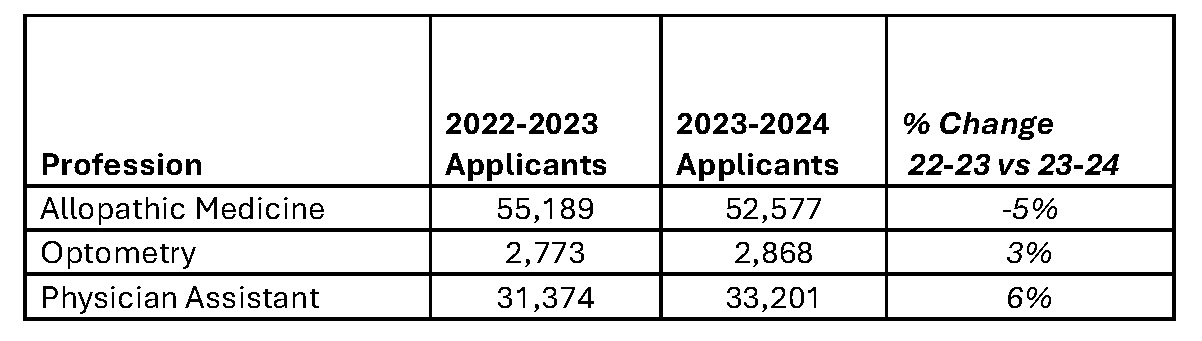
A comparison of applicant rates for Allopathic Medicine, Optometry, and Physician Assistant programs. Click to enlarge
Drop Me a Line
Is Optometry finally turning the corner? Is the Optometry Gives Me Life Campaign, combined with the other efforts profession-wide, finally making a difference? Or is this a one-off? Only time will tell. Hopefully, this is the beginning of a more robust, diverse, qualified applicant pool.
What do you think? Let’s share thoughts and potential strategies. I welcome your insights on this and any topic that is on your mind. Email address below.
Reference
- OptomCAS Applicant Data Reports [Internet]. Rockville, MD: Association of Schools and Colleges of Optometry [cited Oct 16, 2019]. Available from: https://www.optomcas.org/
- Zadnik K, Reich LN. An analysis of the optometric applicant pool relative to matriculants. Optom Vis Sci. 2019 Sep;96(9):637-646.
- Berg B, Causey J, Cohen J, Randolph B, Shapiro D. Current Term Enrollment Estimates: Fall 2023, Herndon, VA: NSCRC. January 2024.
- Brown, DL. Years of rampant expansion have imposed Darwinian survival-of-the-fittest conditions on US pharmacy schools. Am J Pharm Educ.2020;84(10):ajpe8136. doi:10.5688/ajpe8136