PEER REVIEWED
Burnout Among Faculty Members in Optometric Education: a Gender-Based Analysis
Brianne N. Hobbs, OD, PhD, FAAO, and Jason Draper, EdD
Abstract
Burnout among clinicians and educators is a growing problem that poses a threat to faculty vitality. The varied roles that optometric faculty members play in academic settings increase their susceptibility to burnout, especially for women. A national, cross-sectional survey of optometric faculty members identified levels of burnout, factors contributing to burnout and gender-based differences in burnout. The response rate was 28.4% (225 of 793). This study found that women are more likely than men to experience burnout (p < .001) and less likely to report an institutional culture that supports faculty wellness (p = 0.038). Work-life balance, compensation and advancement opportunities may inform these differences. Additional studies are needed to establish whether these factors are statistically significant.
Background
Optometric educators across the United States are active clinicians, scholars and administrators, often expected to serve in these roles within the same day. Whether taking responsibility for the development of their students, providing evidence-based care to their patients or fulfilling the mission of their academic institution, they constantly balance these related but competing interests with the roles they inhabit in their personal lives. This ceaseless balancing act can devolve into role conflict leading to burnout, especially for women.1-5 Existing literature that addresses burnout has almost exclusively focused on larger professions or academic medicine; there is a significant gap in the literature regarding the relationship between gender and burnout among optometric educators.6-8 This study focuses on that gap to contribute to a greater understanding of how gender and burnout intersect in optometric education by identifying contributing factors to burnout that have gender-based differences. A better understanding of the gender-based risk factors for burnout is the first step in creating academic environments where all faculty members can thrive.
The Association of Schools and Colleges of Optometry (ASCO) reports that there are approximately 800 full-time faculty members distributed across 23 schools and colleges of optometry in the United States, 60% of whom are women.9 By comparison, the Association of American Medical Colleges (AAMC ) reports (2024) that there are more than 240 times the number of medical school faculty members (201,112) at medical schools in the United States than there are optometric educators.10 Given the relative dearth of optometric educators, the dynamism required of these professionals to successfully serve in these roles, and the increasingly disproportionate representation of women in these roles, it is critical to understand the factors contributing to attrition, dissatisfaction and burnout especially among women optometric faculty members.
Burnout is described as an “occupational phenomenon” (ICD-11) characterized by three dimensions: “feelings of energy depletion or exhaustion, increased mental distance from one’s job or feelings of negativism or cynicism related to one’s job, and reduced professional efficacy.”11 This article describes burnout in optometric educators and identifies gender-related trends based on a national survey.
Trends in burnout
The COVID-19 pandemic worsened a rising trend of faculty burnout in academic medicine,12-13 especially among women in academic medicine.14 Large-scale studies of burnout in optometric educators have not been done. A single study addressed burnout at one college of optometry, focusing on comparative rates of burnout between academic programs.15 The current study is the first to assess levels of burnout among optometric educators on a national scale.
Studies conducted more broadly in academic medicine and health professions education are applicable given the similar expectations of faculty members across these disciplines. In a representative study of burnout among faculty members at U.S schools of pharmacy, the authors reported that 41.3% of faculty members identified being emotionally exhausted. Emotional exhaustion is a common characteristic of burnout16 and is defined as “emotional and physical depletion without recovery” that leads to occupational disengagement.17 Importantly, this symptom of burnout was noted to be disproportionately prevalent among faculty members at lower academic ranks and those having children age 1-12 years.16 Having children is a particularly common burnout risk factor among medical professionals.18-20 However, support from both colleagues and administrators has been shown to positively impact retention and job satisfaction.21
Impact of gender
The prevalence and severity of burnout is likely impacted by gender.1-2 This disproportionate relationship between burnout and gender is particularly relevant given the over-representation of women in optometry as educators and students. Studies conducted in academic medicine suggest that women faculty members may suffer from higher levels of burnout than their colleagues.2-4 A mismatch between actual percent effort among the various roles a faculty member holds and the priorities for individual faculty members has been shown to contribute to burnout in academic medicine, and this lack of alignment may be particularly impactful for women.7-8 Some studies have estimated that burnout may be 20-50% higher in women than in men.1,22 This is likely based on historical societal expectations and gendered expectations, the workplace gender climate, maternal bias and lack of parity in salary and promotion.12,14,18 Gender climate has been described as the “formal and informal institutional attitudes and programs to promote gender equity in the workplace.”23
Maternal bias occurs when individuals are discriminated against based on their role as a mother. One study found that one-third of physician mothers experienced maternal bias.22 Although gender equity has improved substantially in the workplace and society at large, women are often still viewed as shouldering more of the caretaking tasks in their personal lives.12,14,24 It has been unknown how gender impacts the experience of faculty members as it relates to burnout and work-life balance and to what extent the aforementioned issues impact the work experience of women in optometric education.
Consequences of burnout
Burnout negatively impacts faculty members’ engagement with their students, patients, colleagues and administrators, leaving them less able to fulfill their many roles. Academic medicine studies suggest that burnout increases attrition and decreases productivity.25-26 Additionally, when faculty members are experiencing burnout in their professional lives, they are less able to cope with the challenges in their personal lives and experience higher rates of sleep disorders, depression and pain, and lower levels of coping skills.26
Statement of Purpose
Using the data gathered from a national survey of optometric faculty members,27 we sought to describe quantitatively the degree of burnout among faculty members in the context of optometric education and to identify any differences related to the gender of those faculty members and how they experienced factors related to burnout. The original study from which this subanalysis was derived involved the distribution of the Standpoint™ Faculty Engagement Survey to faculty members at schools and colleges of optometry via ASCO. While the survey broadly addressed many different dimensions of faculty engagement that were described in a prior publication,27 this article focuses specifically on burnout. By providing a description of the level of burnout, the contributing reasons and gender-based factors, the authors hope to help schools and colleges of optometry better understand and address the needs of their faculty in this area.
Methods
Instrument
A modified version of the AAMC’s Standpoint™ Faculty Engagement Survey was used in this study to assess levels of faculty engagement across 17 dimensions. The AAMC Standpoint™ Faculty Engagement Survey was developed by a team of AAMC staff, subject matter experts, clinicians and psychometricians and has been shown to have strong external and internal validity.28-29 This online survey was designed to measure faculty engagement and job satisfaction among faculty members at U.S. medical colleges, but many aspects that influence engagement in academic medicine are also relevant to optometric education. Competing teaching, research, service and patient care roles are not unique to medicine, thus the AAMC Standpoint™ Faculty Engagement Survey is also an appropriate instrument for optometry, dental, chiropractic and pharmacy schools and colleges. To ensure validity of the instrument, only minor modifications were made such as inserting “optometric” or replacing “medicine” with “optometry”; the content of the instrument was preserved in terms of item number and type (Likert scale). Additional slight modifications were required to ensure alignment with the organizational structure and workplace environments of optometry schools and colleges compared to medical schools, but the content of the questions was retained. Due to the proprietary status of the Standpoint™ Faculty Engagement Survey, only portions of the full instrument were included in this article. Of the 15 primary dimensions having Likert-type response scales ranging from 1 – Strongly Disagree to 5 – Strongly Agree, each demonstrated adequate internal consistency reliability with the lowest subscale reliability value being ɑ = 0.774 (compensation) and the highest being ⍺ = 0.950 (departmental governance).
More specific to burnout, this instrument included questions regarding the number of weekly hours, allocation of effort, faculty wellness, intent to leave and self-reported levels of burnout. Each of these aspects has been shown in previous studies to contribute to the complex equation that leads to burnout.2,6-7
Data collection
The target population was paid faculty members at U.S. schools and colleges of optometry. According to ASCO’s Annual Faculty Data Report for academic year 2021-2022, 793 full-time faculty members were distributed across the 23 U.S. schools and colleges of optometry, with approximately 1,100 total paid faculty.9 Following IRB approval from Robert Morris University, we obtained permission from the ASCO Board of Directors to distribute the survey to paid faculty members of member institutions. An introductory email with the accompanying hyperlink for the online survey, built and hosted on the QuestionPro platform, was sent to the executive director of ASCO who then forwarded the email to the deans and presidents of ASCO member institutions. Individual institutional leaders were responsible for forwarding the invitation to participate to their respective faculty members. The invitation included a description of the survey along with an explanation of the purpose of the survey. The informed consent for the survey accompanied the survey, and after informed consent was obtained, faculty members could begin the survey. The survey was open for approximately 30 days in spring 2022. A reminder email was sent with 1 week left in the active window for the survey. All faculty members at the 23 U.S. schools and colleges of optometry with active email addresses had an opportunity to participate in the study; however, some faculty members may not have received the invitation and survey link due to the indirect method of distribution. As participants completed the survey online by accessing a hyperlink, anonymity was preserved as no identifying information was collected and IP addresses were not stored. Self-reported respondent characteristics are reviewed below.
Analysis
The survey data were exported from QuestionPro into SPSS statistical software (version 28) for analysis.30 The data set was trimmed to exclude categories where the expected cases were less than five, which would violate the assumptions of the chi square analysis due to specific assumptions of the statistical analyses conducted.31 Initial descriptive statistics that were calculated included measures of variability and measures of central tendency for summary scores of the topics embedded within the survey. Participation rate and completion rate were also computed, and the results of these calculations have been published elsewhere.27 Chi square tests of independence were performed to determine whether respondent gender was independent from their responses on several items related to burnout. Gender-based analyses were conducted using binary terms (man and woman) because the number of respondents who identified as another gender was insufficient for conducting statistical comparative analyses. Respondents had the freedom to answer or skip items as they chose. The n value is reported for each survey item. Alpha for significance testing was set at 0.05.
Results
Respondents
The final data set used for analysis included 225 total unique respondents. These respondents represent 28.4% of full-time faculty or 20.5% of all paid faculty. Respondents were faculty members at 18 of the 23 (78.3%) ASCO member institutions, with 67 (30.3%) of 221 respondents coming from the institution providing the largest portion of the sample and two institutions providing just one respondent each (0.5%). The median number of respondents per institution was 10. Of the overall sample of respondents, nearly all reported being full-time faculty members (n = 206 of 222, 92.8%). Additionally, most respondents identified as white (n = 141 of 179, 78.8%), a woman (n = 113 of 180, 62.8%) and had a Doctor of Optometry degree without other terminal degrees (n = 178 of 224, 79.5%). Of respondents choosing to answer an item about sexual orientation (n = 181, 80.4%), most identified as being heterosexual (n = 164, 90.4%).
Other defining characteristics of the respondents included in the following analyses were somewhat more varied. Although most respondents (n = 94 of 179, 52.5%) were born between 1977 and 1995 and could be considered Millennials, this nearly 20-year span in the birth year category may suggest a notable variability across these respondents’ experiences as related to age. Just more than half of the respondents (n = 118 of 224, 52.7%) were newer to their institutions, with their tenure ranging from having just started in the current academic year to 10 years. In terms of academic tenure and rank, interestingly, most respondents (n = 128 of 224, 57.2%) reported being Associate or full Professors, but only 34.3% (n = 76) of 222 respondents reported being tenured or on tenure track. Approximately a third of respondents reported that their primary appointment was in primary care (n = 72 of 223, 32.3%) followed by pediatrics/binocular vision (n = 44 of 223, 19.7%). Other primary appointments reported were in ocular disease, cornea/contact lens, basic science and other; each reported by approximately 11% of the respondents. Finally, half (n = 112 of 222, 50.6%) of faculty respondents served in some administrative role in addition to their faculty role.
Faculty wellness
Faculty wellness was one of the lowest-scoring items on the entire survey. More than a third of respondents (36.2%, n = 75 of 207) felt that their optometry school or college did not cultivate faculty wellness. Of those, nearly half (12.6%, n = 26 of 207) strongly disagreed that faculty wellness was emphasized to the correct degree by their home institution. In addition to a relatively low mean compared with other survey items, there was a gender-based statistically significant difference in perceptions of faculty wellness. Women (M = 2.96) were less likely than men (M = 3.37) to respond that the culture at their institution cultivated faculty wellness, t(173) = 2.090, p = 0.038.
Levels of burnout
Of the 183 who responded to this item, 15.3% (n = 28) reported no burnout, 36.6% (n = 67) were at risk of burnout, and nearly half (48.1%, n = 88) reported that they were experiencing self-defined burnout. More pervasive and intense forms of burnout were reported by 15.9% (n = 29) of respondents. Table 1 depicts the levels of burnout and corresponding faculty member responses.
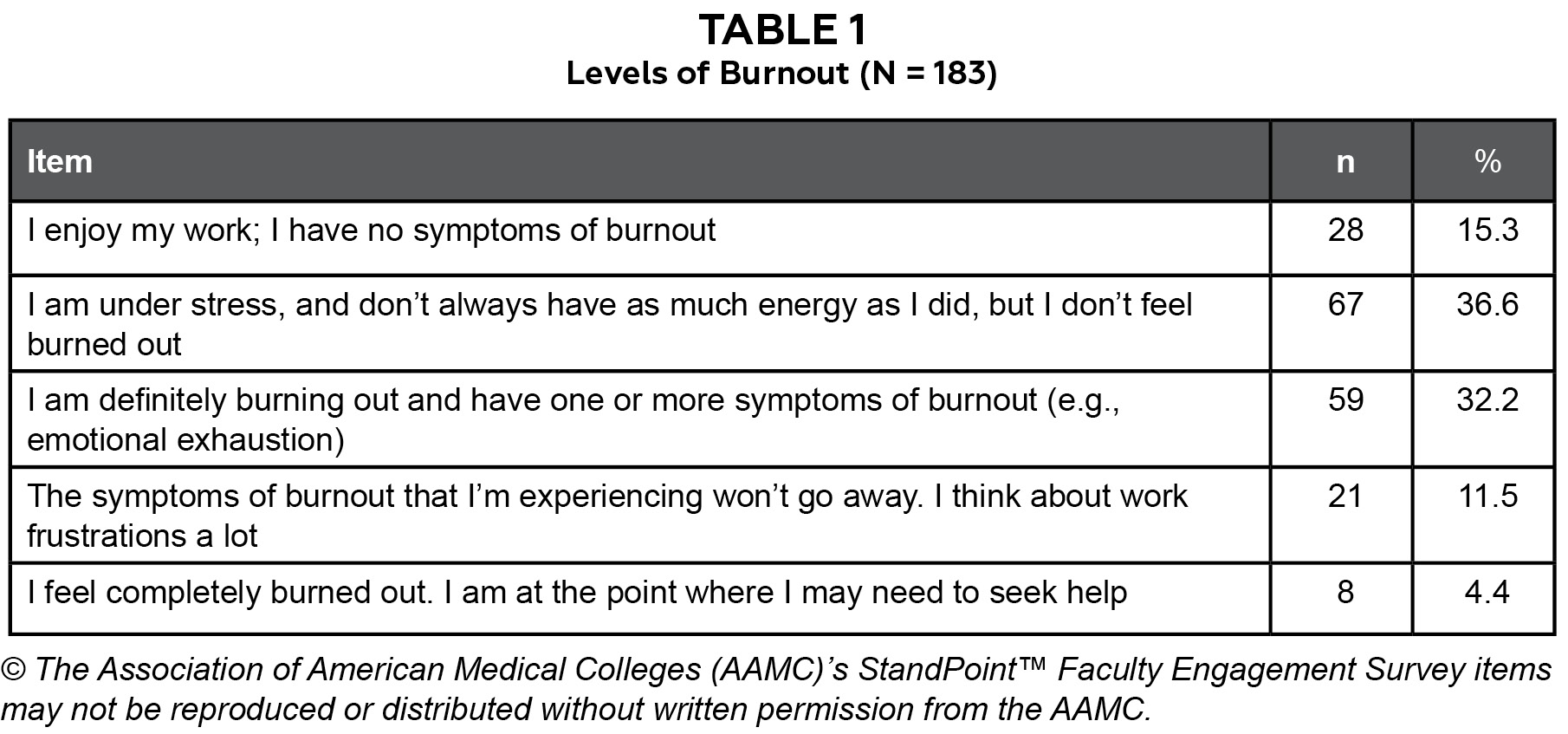 Table 1. Click to enlarge |
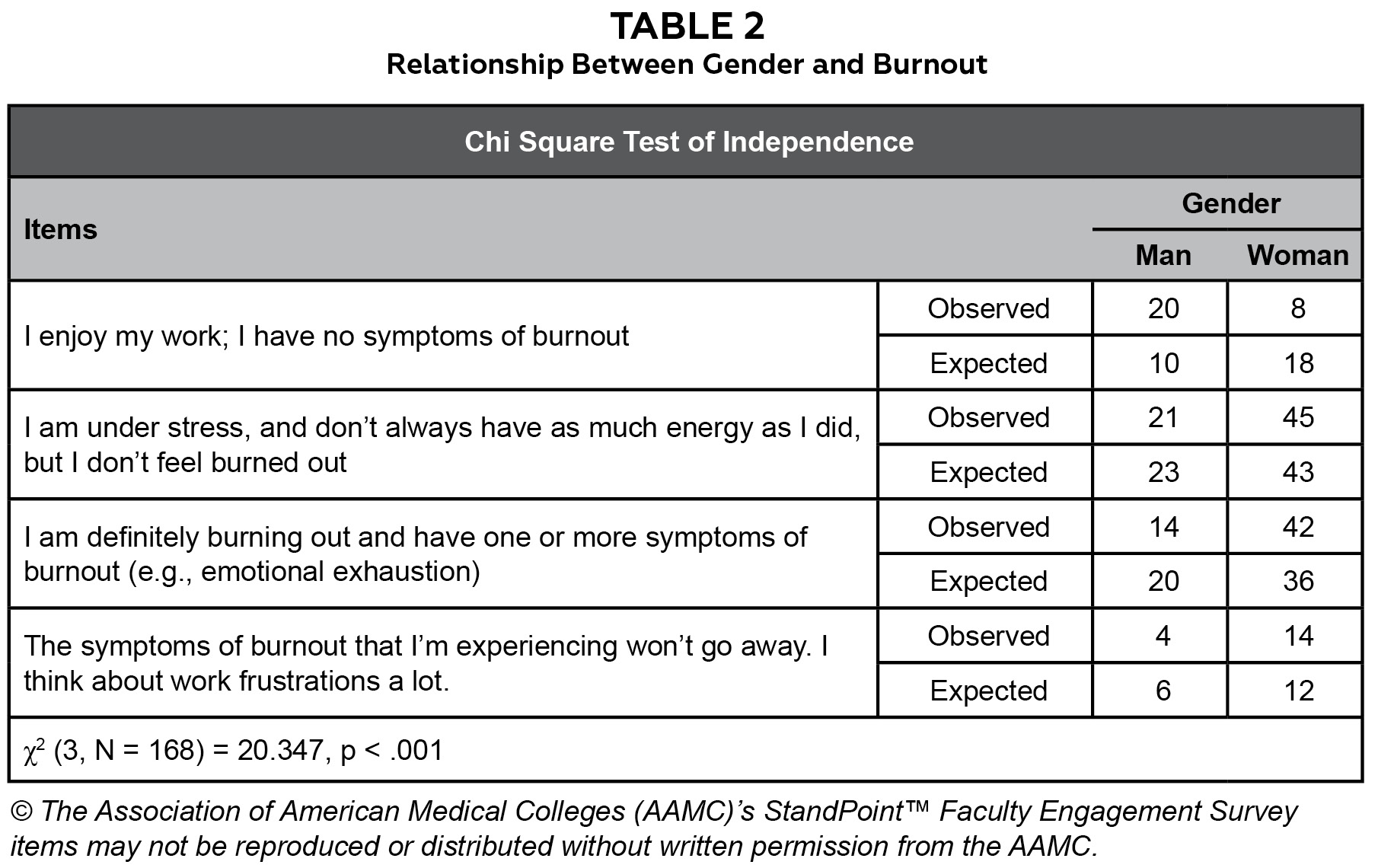 Table 2. Click to enlarge |
A Chi square test of independence was performed to determine whether respondent gender was independent of reported levels of burnout. Observed and expected counts for each answer choice were calculated. The data set was trimmed to eliminate items and gender categories in which expected cell values were less than five. The results of the Chi square test of independence were statistically significant, indicating that gender and burnout were dependent, χ2 (3, N = 168) = 20.347, p < .001. The pattern of responses demonstrated that women experienced higher levels of burnout than expected and men experienced less burnout than expected. Although more women reported burnout at each level, the gender-based difference between expected and observed counts was the largest for the answer choice “I enjoy my work; I have no symptoms of burnout,” where less than half as many women as expected reported no burnout and twice as many men as expected reported no burnout. The most important findings from this analysis indicate that the two categories of burnout in which women were most disadvantaged were in the categories of “no symptoms of burnout” and “definitely burning out.” Table 2 contains the results of the gender-based analysis of burnout using the Chi square test of independence.
Intention to leave
Respondent choices, disaggregated by gender, as to why they might leave their institution are displayed in Table 3. The value in the percentage column indicates the percentage of the respondents of that gender who selected the item as a potential reason for leaving the profession. In nearly every case, a higher proportion of woman respondents than man respondents identified choices as a potential reason for leaving. More than a third of woman respondents (n = 41, 37.6%) reported that work-life balance/burnout was a reason they might leave, but only 20.3% (n = 12) of man respondents reported this as a potential reason to leave. Although slightly fewer woman respondents identified compensation/benefits as a reason they might leave (n = 38, 34.9%), this represented a difference of 18% over the proportion of man respondents who selected this item (n = 10, 16.9%). Women were nearly twice as likely as men to identify advancement opportunities as a reason they would consider leaving (13.6% of men, 25.7% of women). To summarize, the three key differences that appeared to disadvantage women vs. men were work-life balance, compensation and advancement opportunities.
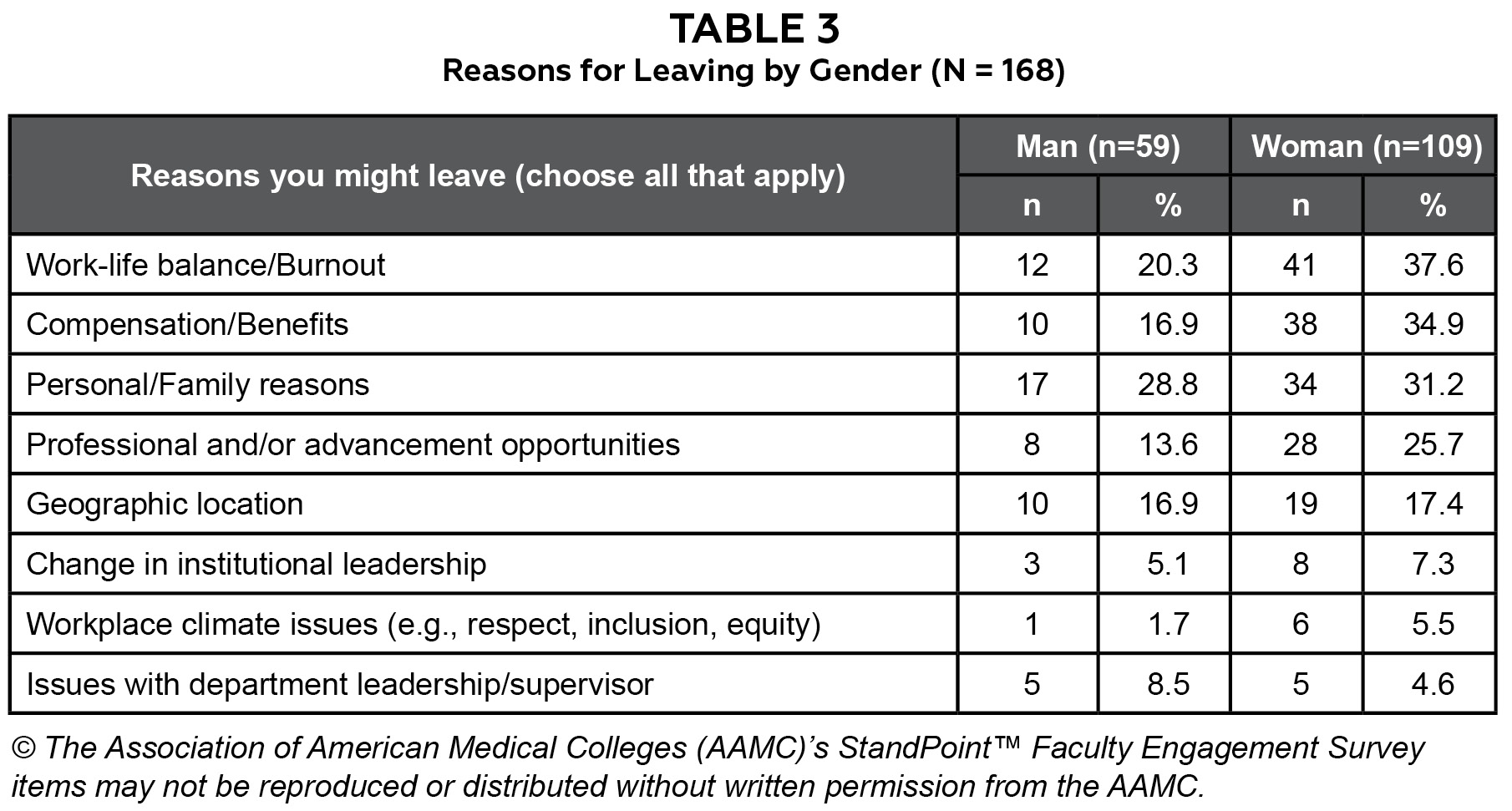
Table 3. Click to enlarge
A Chi square test of independence using the variables gender and how likely the faculty members were to leave their institutions found no significance difference in the likelihood of women and men leaving, χ2 (4, N = 168) = 6.842, p = .144. This finding suggests that although women and men have different reasons for potentially leaving their academic institutions, these gender-based differences do not necessarily translate to how likely the faculty member is to leave. The sample size for this question (n = 168) was smaller than for previous questions. The smaller sample size might have been related to the question’s position in the survey, or respondents may have been hesitant to answer due to the content of the question.
Workload
The results of additional gender-based analyses indicate that there were no statistically significant gender-based differences in the areas of average work hours per week, t(168) = 0.871,p = .385. There was also not a statistically significant impact of gender on the perceptions of time allocation across the major dimensions of faculty responsibilities including teaching t(174) = 1.110, p =.268, research t(174) = 0.267, p = .790, patient care t(174) = 0.218, p = .828, and administration t(174) = 0.472, p = .638. The additional findings seemingly indicate that women and men are doing similar types and amounts of work, at least as measured on a general level by the survey items included in this analysis.
Discussion
Given the gender-related differences in perceptions of faculty wellness, prevalence and severity of burnout, and reasons for leaving the school or college of optometry, it becomes clear that men and women experience the expectations of an optometric educator differently. These findings are consistent with gender-based differences in medicine.5,22-24,32 Women felt more strongly that their institutions did not appropriately prioritize “faculty wellness.” Women were more likely to feel that their wellness was not being prioritized, which may make them more susceptible to burnout. Given differing gender-based role expectations in their personal lives, wellness needs of optometric educators are also likely to vary based on gender. The results presented herein suggest that the specific needs of women optometric educators are neither being fully met nor recognized. Individual faculty wellness is a bulwark against burnout; therefore, it behooves optometric school and college administrators to understand and implement practices that facilitate and support faculty needs.33
The results of this study provide evidence that women in optometric education may be more likely to experience burnout and their experience of that burnout may be more severe than it is for men. This trend is consistent with other studies of women in academic medicine, a disparity that has become even more dramatic since the onset of the COVID-19 pandemic.4,6,14 Because there were no gender-related differences in how much work was performed or the nature of the work, it is likely that the reasons for the disproportionate prevalence of burnout have more to do with other contextual factors.
Workplace climate issues (including respect, inclusion, equity and diversity) were responsible for the largest gender-related difference in satisfaction. Perhaps the most salient indicator of women’s experience and how it relates to burnout were the top reasons women cited for potentially leaving their institution: work-life balance/burnout, family reasons, compensation/benefits and advancement opportunities. Work-life balance has been identified in academic medicine as a factor that disproportionality contributes to burnout in women.1,5 “Family reasons” is another factor that contributes more substantially to burnout in women as measured by previous studies on the subject, but our study did not find a significant difference in this area.2,19,32 Compensation and advancement opportunities are often linked, and women were substantially more likely to leave based on both of these reasons than men. If women feel that they are not being compensated equitably for the same work, it could contribute to disengagement and, ultimately, burnout.34 Equally important, appropriate compensation promotes a feeling of being valued, which is also a protective factor against burnout.34 The gender-based difference in promotion opportunities as a contributor to attrition represents an area for improvement for schools and colleges of optometry.
This study found that women optometric faculty are more likely to experience burnout, a finding consistent with the literature.3,19 This gender-related difference is likely driven by specific evidence from previous work showing that women were five times more likely to stay home to care for a sick child and spent 8.5 more hours per week on domestic activities than their partners.1,5,32 These gendered and disproportionately deleterious expectations likely lead to increased conflict between personal and professional roles for women. According to a large cross-sectional survey of academic physicians, women were more likely to have experienced a recent conflict between their personal and professional lives.1 This conflict between roles leads to increased stress that ultimately contributes to higher levels of burnout. The scope of this study was insufficient to address the complex factors contributing to burnout, but the results indicate that many of the larger trends regarding burnout present in academic medicine may also be relevant to optometric faculty members.
Limitations
This study has multiple limitations. This initial gender-based analysis of burnout was derived from a large, cross-sectional study on faculty engagement and burnout and was not intended to fully address the complex phenomenon of burnout among faculty members in optometric education. The validated instrument used in the study addressed burnout as one dimension of faculty engagement. Future work more narrowly and specifically focused on burnout could be beneficial toward informing how optometric education may best intentionally and effectively support its faculty and insulate them from burnout’s contributing factors.
Examining intersectionality in the context of burnout was also beyond the scope of this study, but other studies in medicine have demonstrated it is an important area that should be addressed in future studies.35-36 Specifically, the majority of respondents in this study were white (78.8%), and those with multiple marginalized identities are likely disadvantaged more severely and correspondingly more vulnerable to burnout than others. This complex interaction between gender, race and burnout warrants additional investigation.
A greater degree of gender inclusivity should be incorporated into future studies on the topic, but the respondent characteristics and the methodology of this study did not facilitate examining the impact of gender except as a binary construct. Ultimately, the research reported here represents the initial effort to understand burnout and the differential experience of burnout by gender in optometric education on a national scale. Toward this end we were successful. However, we acknowledge that more must be done to not only deeply understand burnout, but also to develop interventions that promote the vitality of faculty members in optometric education, regardless of gender.
Conclusion
Women are more likely to experience burnout, a finding of specific importance to optometric education given that most optometric faculty members are women. This analysis addressed a gap in the literature as previous studies have failed to address the topic of burnout among optometric educators. Important findings from this study are that women, more than men, feel that their wellness is not prioritized appropriately, and women are also more likely to list compensation, work-life balance and advancement opportunities as potential reasons to leave their academic institution. Collectively, these findings suggest that to reduce burnout and faculty attrition, culture change across optometric education may be needed to more effectively support a reality where women are the majority of optometric educators.
References
- Dyrbye LN, Shanafelt TD, Balch CM, Satele D, Sloan J, Freischlag J. Relationship between work-home conflicts and burnout among American surgeons: a comparison by sex. Arch Surg. 2011 Feb;146(2):211-7. doi: 10.1001/archsurg.2010.310
- Hoff T, Lee DR. Burnout and Physician Gender: What Do We Know? Med Care. 2021 Aug 1;59(8):711-720. doi: 10.1097/MLR.0000000000001584
- Langballe EM, Innstrand ST, Aasland OG, Falkum E. The predictive value of individual factors, work-related factors, and work-home interaction on burnout in female and male physicians: a longitudinal study. Stress and Health. 2010 May 6;27(1):73-87. doi: https://doi.org/10.1002/smi.1321
- Lorello GR, Gautam M, Barned C, Peer M. Impact of the intersection of anaesthesia and gender on burnout and mental health, illustrated by the COVID-19 pandemic. Anaesthesia. 2021 Apr;76 Suppl 4(Suppl 4):24-31. doi: 10.1111/anae.15360
- Guille C, Frank E, Zhao Z, et al. Work-family conflict and the sex difference in depression among training physicians. JAMA Intern Med. 2017 Dec 1;177(12):1766-1772. doi: 10.1001/jamainternmed.2017.5138
- Matulevicius SA, Kho KA, Reisch J, Yin H. Academic medicine faculty perceptions of work-life balance before and since the COVID-19 pandemic. JAMA Netw Open. 2021 Jun 1;4(6):e2113539. doi: 10.1001/jamanetworkopen.2021.13539
- Zimmermann EM, Mramba LK, Gregoire H, Dandar V, Limacher MC, Good ML. Characteristics of faculty at risk of leaving their medical schools: an analysis of the StandPoint™ Faculty Engagement Survey. J Healthc Leadersh. 2020 Jan 8;12:1-10. doi: 10.2147/JHL.S225291
- Pollart SM, Novielli KD, Brubaker L, et al. Time well spent: the association between time and effort allocation and intent to leave among clinical faculty. Acad Med. 2015 Mar;90(3):365-71. doi: 10.1097/ACM.0000000000000458
- Annual Faculty Data Report, Academic Year 2021-2022 [Internet]. Rockville, MD: Association of Schools and Colleges of Optometry. Available from: https://optometriceducation.org/wp-content/uploads/2022/03/ASCOAnnFacDataRepforWebsite2021-22.pdf
- 2023 U.S. Medical School Faculty [Internet]. Washington, DC: Association of American Medical Colleges. Available from: https://www.aamc.org/data-reports/faculty-institutions/report/faculty-roster-us-medical-school-faculty
- Burn-out an “occupational phenomenon”: International Classification of Diseases [Internet]. World Health Organization; 2019 May 28. Available from: https://www.who.int/news/item/28-05-2019-burn-out-an-occupational-phenomenon-international-classification-of-diseases
- Amanullah S, Ramesh Shankar R. The impact of COVID-19 on physician burnout globally: a review. Healthcare (Basel). 2020 Oct 22;8(4):421. doi: 10.3390/healthcare8040421
- Khalafallah AM, Lam S, Gami A, et al. Burnout and career satisfaction among attending neurosurgeons during the COVID-19 pandemic. Clin Neurol Neurosurg. 2020 Nov;198:106193. doi: 10.1016/j.clineuro.2020.106193
- Brubaker L. Women physicians and the COVID-19 pandemic. JAMA. 2020 Sep 1;324(9):835-836. doi: 10.1001/jama.2020.14797
- Patel PB, Hua H, Moussavi K. Burnout assessment at a college of pharmacy, college of optometry, and school of physician assistant studies. Curr Pharm Teach Learn. 2021 Aug;13(8):914-921. doi: 10.1016/j.cptl.2021.06.010
- El-Ibiary SY, Yam L, Lee KC. Assessment of burnout and associated risk factors among pharmacy practice faculty in the United States. Am J Pharm Educ. 2017 May;81(4):75. doi: 10.5688/ajpe81475
- Lee KC, Fairman KA, El-Ibiary SY. Item analysis of emotional exhaustion in pharmacy practice faculty. Curr Pharm Teach Learn. 2020 May;12(5):504-507. doi: 10.1016/j.cptl.2020.01.003
- Drudi LM, Nishath T, Ma X, Mouawad NJ, O’Banion LA, Shalhub S. The impact of the COVID-19 pandemic on wellness among vascular surgeons. Semin Vasc Surg. 2021 Jun;34(2):43-50. doi: 10.1053/j.semvascsurg.2021.04.003
- McMurray JE, Linzer M, Konrad TR, Douglas J, Shugerman R, Nelson K. The work lives of women physicians results from the physician work life study. The SGIM Career Satisfaction Study Group. J Gen Intern Med. 2000 Jun;15(6):372-80. doi: 10.1111/j.1525-1497.2000.im9908009.x
- Shanafelt TD, Balch CM, Bechamps GJ, et al. Burnout and career satisfaction among American surgeons. Ann Surg. 2009 Sep;250(3):463-71. doi: 10.1097/SLA.0b013e3181ac4dfd
- Pololi LH, Krupat E, Civian JT, Ash AS, Brennan RT. Why are a quarter of faculty considering leaving academic medicine? A study of their perceptions of institutional culture and intentions to leave at 26 representative U.S. medical schools. Acad Med. 2012 Jul;87(7):859-69. doi: 10.1097/ACM.0b013e3182582b18
- Templeton K, Bernstein CA, Sukhera J, et al. Gender-based differences in burnout: issues faced by women physicians [Internet]. National Academy of Medicine; 2019 May 30; Available from: https://nam.edu/gender-based-differences-in-burnout-issues-faced-by-women-physicians/
- Carr PL, Gunn CM, Kaplan SA, Raj A, Freund KM. Inadequate progress for women in academic medicine: findings from the National Faculty Study. J Womens Health (Larchmt). 2015 Mar;24(3):190-9. doi: 10.1089/jwh.2014.4848
- Heath I. Women in medicine. BMJ. 2004 Aug 21;329(7463):412-3. doi: 10.1136/bmj.329.7463.412
- Dewa CS, Loong D, Bonato S, Thanh NX, Jacobs P. How does burnout affect physician productivity? A systematic literature review. BMC Health Serv Res. 2014 Jul 28;14:325. doi: 10.1186/1472-6963-14-325
- Salvagioni DAJ, Melanda FN, Mesas AE, González AD, Gabani FL, Andrade SM. Physical, psychological and occupational consequences of job burnout: a systematic review of prospective studies. PLoS One. 2017 Oct 4;12(10):e0185781. doi: 10.1371/journal.pone.0185781
- Hobbs BN. Faculty vitality in U.S. schools and colleges of optometry: a mixed methods study; 2022, doctoral dissertation, Robert Morris University [Internet]. ProQuest Dissertations and Theses Global. Available from: https://www.proquest.com/openview/1dcd491b6babf50295957625b67f4322/1?pq-origsite=gscholar&cbl=18750&diss=y
- Bunton SA, Corrice AM, Pollart SM, et al. Predictors of workplace satisfaction for U.S. medical school faculty in an era of change and challenge. Acad Med. 2012 May;87(5):574-81. doi: 10.1097/ACM.0b013e31824d2b37
- StandPointTM Faculty Engagement Survey [Internet]. Washington, DC: Association of American Medical Colleges; c2024. Available from: https://www.aamc.org/services/member-capacity-building/standpoint-surveys/faculty-engagement-survey
- IBM Corp, Armonk, NY. IBM SPSS Statistics for Macintosh, Version 28.0, released 2021.
- Gravetter FJ, Wallnau LB. Statistics for the behavioral sciences. 10th ed. Boston, MA: Cengage; 2017.
- Jolly S, Griffith KA, DeCastro R, Stewart A, Ubel P, Jagsi R. Gender differences in time spent on parenting and domestic responsibilities by high-achieving young physician-researchers. Ann Intern Med. 2014 Mar 4;160(5):344-53. doi: 10.7326/M13-0974
- Dankoski ME, Palmer MM, Nelson Laird TF, Ribera AK, Bogdewic SP. An expanded model of faculty vitality in academic medicine. Adv Health Sci Educ Theory Pract. 2012 Dec;17(5):633-49. doi: 10.1007/s10459-011-9339-7
- Simpkin AL, Chang Y, Yu L, Campbell EG, Armstrong K, Walensky RP. Assessment of Job Satisfaction and Feeling Valued in Academic Medicine. JAMA Intern Med. 2019 Jul 1;179(7):992-994. doi: 10.1001/jamainternmed.2019.0377
- Cropsey KL, Masho SW, Shiang R, Sikka V, Kornstein SG, Hampton CL; Committee on the Status of Women and Minorities, Virginia Commonwealth University School of Medicine, Medical College of Virginia Campus. Why do faculty leave? Reasons for attrition of women and minority faculty from a medical school: four-year results. J Womens Health (Larchmt). 2008 Sep;17(7):1111-8. doi: 10.1089/jwh.2007.0582
- Carr PL, Gunn CM, Kaplan SA, Raj A, Freund KM. Inadequate progress for women in academic medicine: findings from the National Faculty Study. J Womens Health (Larchmt). 2015 Mar;24(3):190-9. doi: 10.1089/jwh.2014.4848