Special Report
Results and Action Plans from an Optometric Education Global Summit
Melissa A. Vitek, OD, FAAO, PNAP, and Timothy A. Wingert, FAAO, Dipl
Summary
In October 2019, the Association of Schools and Colleges of Optometry, the American Academy of Optometry and the World Council of Optometry designed and hosted a Global Optometric Education Summit. The summit included optometrists from around the world and achieved its goal: to promote understanding and open lines of communication between optometric education programs around the world to develop opportunities for advancing optometric education globally. The substance of discussions and action plans that emerged are reported here and revealed that many of the issues and opportunities facing optometric education are shared by institutions around the world.
Thank you to all of the dedicated optometric educators who contributed to the planning and execution of the Global Optometric Education Summit: Barbara Caffery, Elizabeth Hoppe, Scott Mundle, Glen Steele, Hector Santiago, Luigi Bilotto, Ariela Gordon-Shaag, Daniel Taylor, John Nishimoto, Peter Hendicott, Pete Haydon, Suit May Ho, and Nick Rumney.
Background
The optometric profession is practiced differently across the world. While the shared goal is to provide patients with excellent vision and eye health, the level of training and scope of practice vary from country to country. Over time, numerous articles have been written to convey the conditions in different regions, aspirations for the future and hurdles to overcome.1-13 Conversations aimed at strengthening cooperation between and among countries and programs have occurred for nearly 40 years.1 During that time, several conferences have been conducted involving different organizations addressing various topics in optometric education.
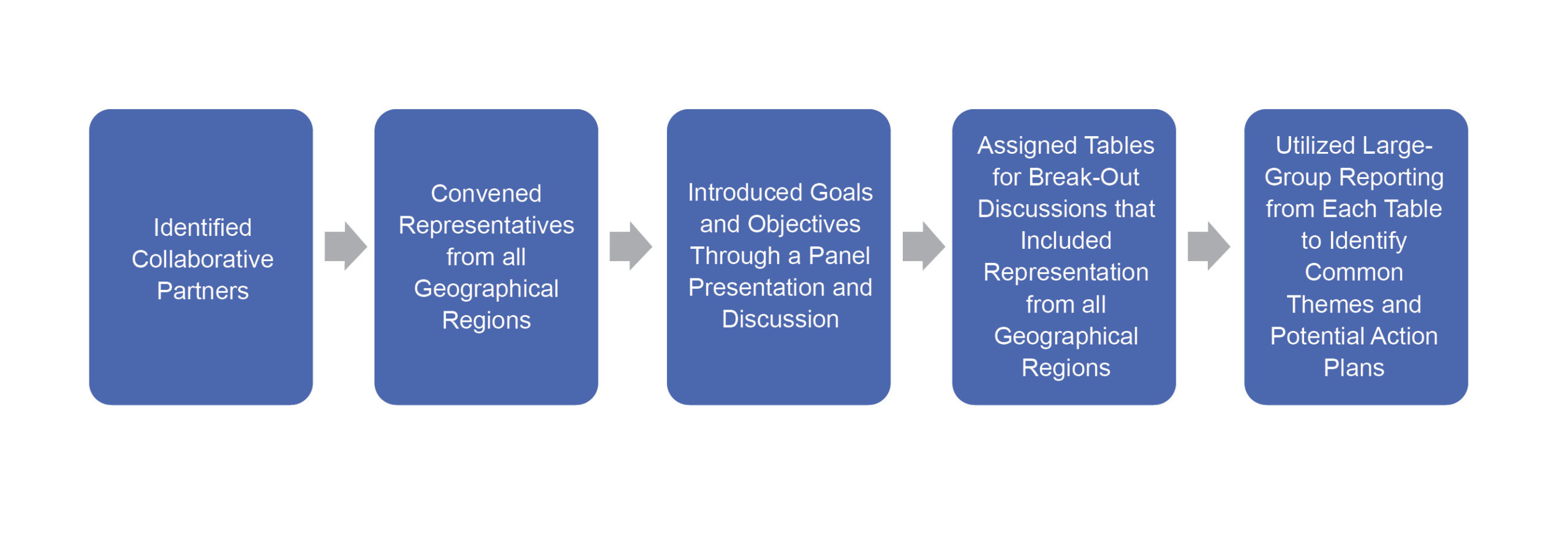
Figure 1. At the Global Optometric Education Summit, participants were seated so that each table included at least one participant from each of the World Council of Optometry representative regions. After a panel of optometric leaders from around the globe provided content relative to each of the goals, the participants discussed each topic within their groups. Each of the 12 groups identified challenges and opportunities that emerged from their respective discussions. The groups reported out to the larger group and submitted a written summary of their conclusions. At the conclusion of the summit, the comments from each group were collected. Click to enlarge
The most recent was held on Oct. 27, 2019, when three organizations, the Association of Schools and Colleges of Optometry (ASCO), the American Academy of Optometry (AAO) and the World Council of Optometry (WCO) designed and hosted a Global Optometric Education Summit during the joint AAO/WCO meeting. This summit brought together optometrists with three goals: to assemble representatives from optometric academic institutions around the world and identify issues facing optometric education globally; to share current best practices in optometric education; and to share ideas on future developments in optometric education. The three goals were linked to key objectives that were defined for the participants: share geographically specific challenges facing optometric education; identify synergies in addressing the challenges facing optometric education; share outcome measures for program effectiveness; explore solutions for deficiencies in and/or threats to resources; communicate techniques and strategies for faculty recruitment, development and retention; identify and share effective tools to assess student learning; and explore future trends in the optometric profession and how institutions will prepare for important changes.
The participants were seated so that each table included at least one participant from each of the WCO representative regions. Following a panel of optometric leaders from around the globe providing content relative to each of the goals, the participants discussed each topic within their groups. Each of the 12 groups identified challenges and opportunities that emerged from their respective discussions. The groups reported out to the larger group and submitted a written summary of their conclusions (Figure 1). At the conclusion of the summit, the comments from each group were collected.
During the process of synthesizing the collected data, several common themes, concerns and potential solutions arose. The challenges and opportunities for each goal are summarized below.
Goal 1: Assemble representatives from optometric academic institutions around the world and identify issues facing optometric education globally
Objectives
- Share area-specific challenges facing optometric education
- Identify synergies in addressing the challenges facing optometric education
Goal 1 challenges
Curriculum, faculty and leadership
The following curricular, faculty and leadership challenges for Goal 1 were identified by each table in varying capacities:
- academic leadership development
- access to master’s level training
- faculty and staff development
- need for curriculum benchmarking
- resistance to change/innovation
The need for academic leadership development was shared by all geographical regions as the profession does not have a widely recognized and/or standardized approach to identifying and cultivating future thought leaders. A unified approach to this could assist in effectively achieving many of the goals discussed during the summit. Similarly, the concept of mutually beneficial mentorship relationships was explored. Also germane to this discussion was access to master’s degree training. For institutions outside of the United States, this type of training signifies advanced clinical and/or research skills and is also a pathway into faculty positions and academic leadership. Interconnected to leadership development, faculty and staff development was described as a challenge due to varying skill sets among both faculty and staff in addition to varying levels of motivation. Furthermore, teaching and assessment models are constantly evolving. Finally, the emergence of new content areas, such as telehealth, were considered. These areas will present a gap in faculty skillsets that will need to be addressed. While a systematic approach to offer leadership, faculty and staff growth and mobility was championed, resources to fully support these types of initiatives are needed.
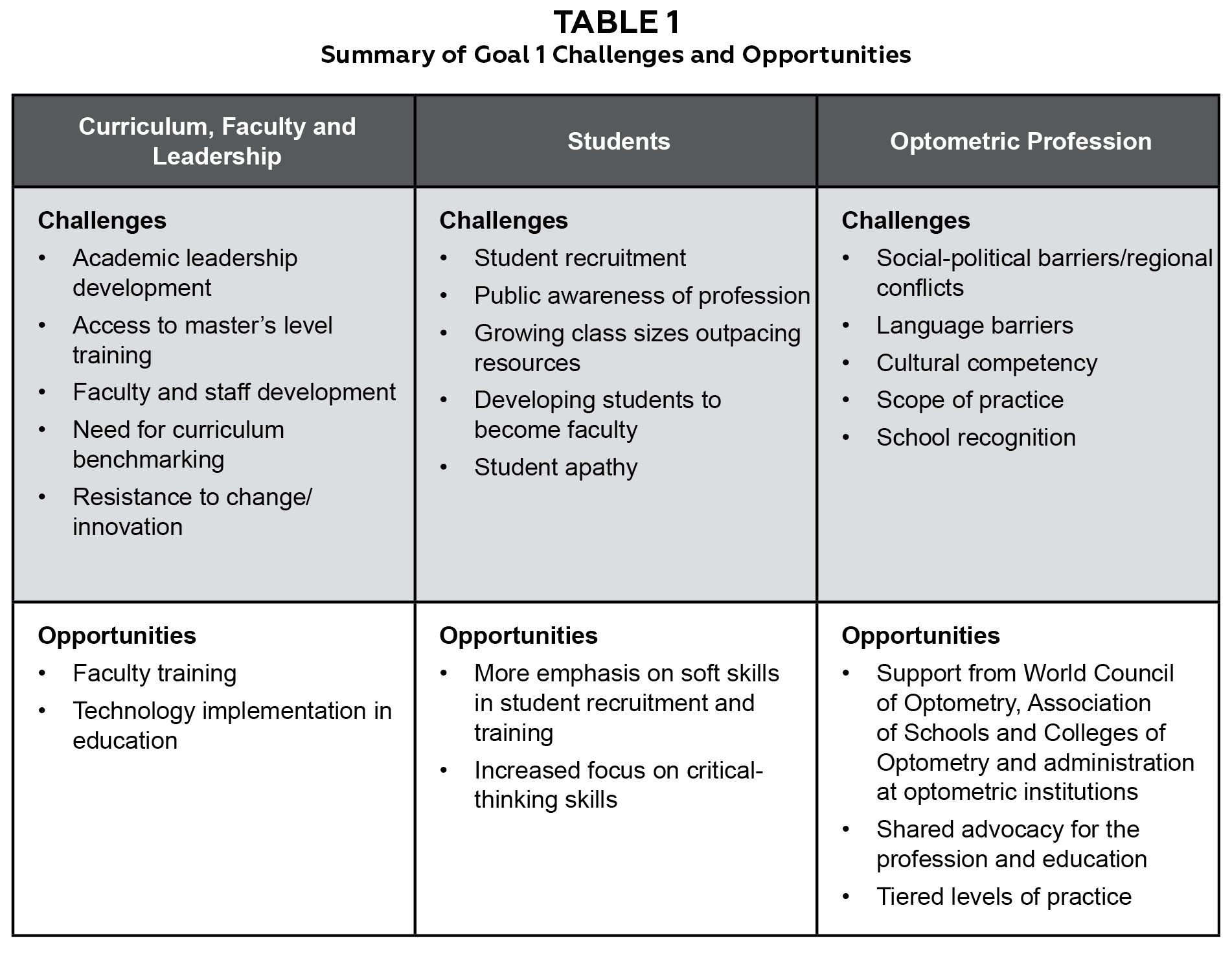
Table 1. Click to enlarge
The topic of curriculum benchmarking linked to discussion on scope of practice, and ultimately patient outcomes was explored. If we are to further solidify the identity of our profession, we need to have a widely accepted mechanism by which to measure the impact our curricula have on patient-important outcomes. The WCO has done extensive work in this area and continues to serve as a valuable resource.14 In addition to the high-level perspectives captured in this model, perhaps working groups aimed at sharing curricular highlights among partner institutions could lead to strengthened programs for all. Similarly, the pros of exploring curriculum gaps and emerging program needs with a unified approach was explored.
Resistance to change is human nature. There was significant dialogue regarding the need to innovate in terms of our chosen content topics, use of technology, pedagogical delivery model, etc., and the resistance that might arise from faculty, accreditation bodies and legislative entities. Effective professional development initiatives could serve as a pathway to mitigating some of that resistance and/or establishing mechanisms to move forward creatively within existing guardrails.
The topic of the need to support continued innovation broadened to encompass practitioners already in the field. Are they practicing to the fullest scope of the profession? If not, why? The following factors were brought forward as possible reasons:
- socio-political barriers, including resistance from ophthalmology (further need to align education with legislation)
- need to adopt and or integrate into an interprofessional practice delivery model
- do we have an appropriate level of flexibility as a profession? (continuing education needed to facilitate early adopters of effective technology)
The likelihood that developing countries may be more poised to be the early adaptors for some types of technological advancements was examined and agreed upon on for certain levels. For example, institutions that reside in regions where accrediting bodies don’t have as much impact on program approaches have additional flexibility that can be utilized in this regard.
Students
The following student-related challenges for Goal 1 were revealed by each table:
- student recruitment
- public awareness of profession
- growing class sizes outpacing resources
- developing students to become faculty
- student apathy
Student recruitment was expressed as a current challenge for all. Creating an enduring pipeline for applicants that have a strong understanding of the profession was a topic of particular emphasis as it speaks to sustainability of the profession and, as a result, patient access to care. It was determined that we could work harder at reaching out to students in high school (or even younger) to educate them on the profession and the typical pathways taken to pursue a career in optometry. In some regions, such as North America, there were concerns as to the growing number of optometry schools while others noted a small and/or shrinking applicant pool.
A common conversation thread existed through all geographical regions on the need for increased awareness by the public in general as to what specific role an optometrist plays in health care. Regardless of geographical area, the representatives from each table concluded that many members of the general population simply don’t have a solid concept of that role. The recent campaign by North American-based ASCO ― “Optometry Gives Me Life” ― targets prospective school applicants, but doesn’t draw a direct connection to what is entailed in the services provided by an optometrist. More needs to be done about expanding the working knowledge of the unique value optometrists bring to a patient’s healthcare team to fully address issues surrounding the profession’s identify. Successful efforts to this end could serve to both shore up a well-informed applicant pipeline and appropriately elevate the status of the profession.
Of equal importance is the need to extrapolate this normalization of the knowledge of optometry’s professional identify to creating a shared vision of where the profession is headed. Many at the summit agreed that we need to embrace evidence-based practice, interprofessional education and technological advancements to remain relevant and sustainable.
Another topic considered was the rising pressure to increase class size to maintain financial viability for programs. As class sizes grow, additional resources are required to meet diverse and expanding student needs, and securing quality candidates becomes more challenging. Due to a decreased tolerance for rising tuition costs, could partnering with industry help mitigate some of these pressures? Could online program offerings provide an opportunity for the reallocation of resources?
Faculty members are typically recruited through residency programs. There was deliberation on whether this approach should be expanded to recruit a more diverse group of faculty members. Should we be reaching into the community and engaging more adjunct faculty members to enrich the students’ experience as well to combat decreases in resources? Perhaps grooming students who demonstrate potential as educators and/or leaders while they are still students could facilitate the development of a strong faculty and/or administrative pipeline?
Finally, growing student apathy was identified as a shared challenge among the various geographical regions. While the need to create lifelong learners was widely accepted, rich discussion centered on how to engage students at a higher level during their academic programs.
Optometric profession
The following profession-specific challenges for Goal 1 were illuminated by the representatives at each table:
- social-political barriers/regional conflicts
- language barriers
- cultural competency
- scope of practice
- school recognition
In addition to the shared challenges discussed above, some regions face ongoing disruption, and sometimes even violence, in their communities that present an additional layer of burden. Faculty and student recruitment, cultural competency (including language barriers) and professional advocacy all become more difficult yet essential in the impacted regions.
Discussions on school recognition were tied to broader deliberations on professional identity and student and faculty recruitment. The reality that some institutions and/or faculty members may be reticent to share granular details with partner institutions to maintain a competitive edge was addressed, but certainly not resolved.
Goal 1 opportunities
Along with the challenges considered for Goal 1, groups were also able to underscore opportunities that could be pursued.
Curriculum, faculty and leadership
The following faculty and administrative opportunities for Goal 1 were brought forth by each table:
- faculty training
- technology implementation in education
It was agreed that establishing and strengthening collaborations between institutions would be beneficial for many programs. Newer programs could learn from established programs, and established programs would be exposed to other ways of doing things that would reinforce what they have already incorporated at their home institution. This could also allow opportunities for interdisciplinary collaboration between optometry schools and other healthcare programs.
Other opportunities centered around training faculty and upgrading the training for optometrists who are already in practice. Often, faculty are recent graduates of the institution in which they now teach. Additional courses to train them beyond the level of that program would give them a greater depth of knowledge to impart to their students. This was something participants felt was very desirable. It was suggested that recently retired faculty from other institutions could be an asset for educators at newer institutions. The seasoned educators could serve as role models and mentors. Part of the concern in recruiting quality faculty was being able to provide a salary that would be competitive with that of a private practitioner. It was mentioned that some small specialty areas, for which a faculty member would be unaffordable, could perhaps be addressed through distance learning programs using experts from afar. This would allow a small topical area that could not sustain an entire faculty to be covered in the curriculum as part of another course without the expense of bringing in a guest lecturer. Concerns that were discussed relative to this had to do with copyright issues and accrediting body approval. While much was discussed about embracing technology and teaching and the use of apps to augment lessons, there is probably greater acceptance of this now as everyone has been teaching remotely for the past 2 years due to the pandemic.
Students
Corresponding to Goal 1, opportunities to recruit students better poised for the evolving demands of the profession were identified as:
- more emphasis on soft skills in student recruitment and training
- increased focus on critical-thinking skills
Most groups hoped that embracing technology and the use of apps in teaching the science would allow for emphasizing critical-thinking and soft skills in the classroom setting. It was also felt that the technological advancements could lead to enhanced collaborations with other schools and other healthcare disciplines.
Optometric profession
The following profession-wide opportunities were highlighted by each table in connection to Goal 1:
- support from WCO, ASCO and administration at optometric institutions
- shared advocacy for the profession and education
- tiered levels of practice
It was felt that some of the advocacy conducted on behalf of the profession should be directed to supporting optometric education as students will become the profession of the future and advocate for the profession down the road. Part of that advocacy could be accompanied by WCO membership after an appropriate level of training has been attained. With a higher level of training, an active optometric association could be formed in the country to help advocacy efforts internally.
Thought was given to considering different levels of optometry to better meet the needs of patients. All optometrists would not need to be trained to the highest level of practice, if those practicing at a different level were in greater demand and less expensive to train. However, there were concerns that creating another level of practitioner would be confusing to the public and other healthcare providers. There was also discussion about cooperation between ophthalmology and optometry related to providing patient care and educating future optometrists to optimize the education and have a better appreciation of how they complement each other. Tiering the profession of optometry might make the distinction between optometry and ophthalmology even more confusing.
Goal 2: Share current best practices in optometric education
Objectives
- share outcome measures for program effectiveness
- explore solutions for deficiencies in and/or threats to resources
- communicate techniques and strategies for faculty recruitment, development and retention
- identify and share effective tools to assess student learning
Goal 2 challenges
Curriculum, faculty and leadership
The following curricular, faculty and leadership challenges related to Goal 2 were elucidated by each table:
- interaction levels and quality control in virtual learning
- match assessment techniques to course content/level
- alignment of competencies assessed on national board examinations and in optometry program curricula
- remove inconsistencies based on geographical area
The need to address this challenge was accelerated when the COVID-19 global pandemic thrust everyone into a virtual learning environment. Many of those who identified themselves as learning/teaching/meeting more effectively face-to-face had to embrace virtual platforms to survive. Ongoing retrospective and prospective studies are collecting data to provide information on best practices. Faculty and administrators are continuing to reflect upon lessons learned and innovative approaches that are here to stay.

Table 2. Click to enlarge
Student assessment is an important topic that speaks to practitioner competency and preparedness for lifelong learning. While the focus was formerly on curricular elements, greater emphasis is being placed on how we are ensuring that students are learning the content we are choosing to include in their degree programs. There are different assessment techniques designed to best measure student learning that takes place in various environments. For example, are there methods for which we can more objectively assess clinical competency?
Of equal importance is evaluating the alignment of the competencies assessed on licensing examinations with those emphasized in the relevant degree programs. Of note is that several regions throughout the world do not have a standardized examination linked to license acquisition.
Finally, the subject of faculty compensation arose. In the changing higher education landscape, are colleges and schools of optometry poised to offer competitive faculty salaries? Some ideas for value added for faculty recruitment were unique faculty development opportunities, clearly defined pathways for growth and creative ideas for mentorship that lead to more career fulfillment.
Additionally, some regions across the globe are severely understaffed. Can virtual platforms provide much needed support for the faculty that are working in such environments?
Students
The following student-related challenges commensurate to Goal 2 were illuminated by each table:
- evolving student expectations
- technology: is it distracting from patient interaction?
- more diverse cultural differences
Students are expecting more for their tuition dollars in addition to desiring more control over their learning environments. To stay competitive, programs need to continuously engage students on their preferences while also measuring this against student performance.
The technology boom has brought “bright new shiny objects” to the classroom, the laboratory and the clinical setting. Ensuing that students are taught that the focus should still be placed on the patient is critical.
Student bodies are becoming more and more diverse. This diversity enriches the experiences of all, but also comes with unique concerns that need to be properly addressed.
Optometric profession
The following profession-specific challenges corresponding to Goal 2 were discussed by the representatives at each table:
- program regulation
- benchmarking of curricular and student outcomes
- need for national board examinations in certain regions
- professional fees for optometrists that are in line with other healthcare provider fees
Optometry program regulation with standardized approaches to accreditation vary greatly around the world. The advantages of regulation are that prospective candidates, graduates and the public have the assurance of a certain level of consistency and quality for accredited programs. A disadvantage may be that the accreditation bodies have the power to hinder innovation if they do not adjust expectations and regulations in alignment with advancements in delivery models, etc.
As mentioned previously, discussions relative to the need to confirm that curricular outcomes are evaluated in the context of all relevant student outcomes is important.
Another important topic addressed was professional fees for optometrists. Is the profession keeping in step with adjustments made in other healthcare professions? If not, what are the advocacy actions needed? Can shared resources assist in standardizing approaches across geographical and geopolitical settings?
Goal 2 opportunities
Along with challenges associated with Goal 2, groups were able to spotlight opportunities that could be pursued.
Curriculum, faculty and leadership
In alignment with Goal 2, the following opportunities were dissected:
- flipped classrooms and evidence-based practice
- specialized training programs to promote practicing at the highest level
- global training opportunities
- innovation in teaching, practice and patient care
- leveraging technology for offering more choices in teaching, student assessment and program assessment
With the student of today being different than the student of 20 years ago, ongoing innovation in teaching and practice is a must. Like advances in all other aspects of life, teaching must move forward to use new technologies and keep students engaged. As students becoming professionals are expected to become lifelong learners to stay current with best practices, educators must additionally stay current on teaching approaches. This requires them to keep abreast of advances in teaching as well as in the profession. Incorporating technology into programs for student assessment, patient simulations and monitoring outcome measures was discussed to expand teaching opportunities and reduce costs. The conversation also revealed that technology often has an upfront cost that can make it difficult to implement. Partnering with other groups may reduce the financial impact by creating cost-sharing opportunities.
The development of global training opportunities was one avenue discussed as a possible way to provide education in some areas to foster advancement of the profession. This could allow for more specialized training in areas that require unique skillsets, such as low vision, geriatrics, pediatrics and contact lenses, and would also reduce the financial impact of the training as the specialty topics would not require the addition of another full-time faculty member. It would allow for the training to be conducted by a content expert and not someone with limited expertise in the subject, while laying the foundation to ensure the profession is practiced at the highest level. Additionally, partnerships between institutions could offer opportunities for faculty to pursue advanced degrees that would strengthen teaching programs for the longer term.
Using the approach of flipped classrooms was advocated to increase student engagement. Evidence-based approaches would be part of the discussions to reinforce for students the concept that the science behind patient care continues to evolve. Along with this approach there was a desire to provide more formative feedback in student learning and have more training in cultural respect. The hope was to better align student competencies with patient expectations.
Students
The following student-related challenges commensurate to Goal 2 were highlighted:
- enhancing skills that promote lifelong learning
- maximizing use of feedback to boost student learning
- better alignment of student competencies and patient expectations
The opportunities mentioned centered around creating practitioners who are truly caring doctors and not technicians. The emphasis was on human interaction and recognizing the value of the patient in the room as a person. The desire was to create an education program that not only taught students the necessary materials, but presented the materials in such a way that students understood the need for, and internalized the desire for, lifelong learning. The desire was expressed to construct feedback for students in such a way that it motivated them to pursue additional knowledge independent of faculty guidance.
Optometric profession
The following profession-wide opportunity relative to Goal 2 was identified by each table:
- increased partnerships with all stakeholders
Increased partnerships with all stakeholders were mentioned consistently among all summit participants. The partnerships began with the recognition of what the optometry profession contributes to improving the quality of life for everyone. With that recognition there needs to be an understanding of all that is involved in optometric education and support for that training. It is a mutual support process with optometric education continuing to improve people’s health and quality of life. Optometric education needs to be a partner with practitioners, industry, other healthcare providers and government to be involved in decisions that improve population health.
Goal 3: Share ideas on future developments in optometric education
Objective
- explore future trends in the optometric profession and how institutions will prepare for important changes
Goal 3 challenges
Curriculum, faculty and leadership
The attendees focused on the following challenges specific to curriculum, faculty and leadership:
- current inconsistencies in the workforce (inclusive of faculty and leadership)
- what are the minimum areas of competency and defined levels to earn the title “optometrist”?
As mentioned previously, some institutions are facing critical scarcity in number of faculty members and/or breadth and depth of knowledge and skills. As the scope of practice has evolved, it is imperative that optometrists retain ownership of the fundamental skills that have defined our profession since its inception. Additionally, the need for more specialized training in areas such as the visual sciences, myopia control and traumatic brain injury was identified as an effective pathway to best student, and ultimately, patient outcomes.
An ongoing point of discussion for the profession from a global perspective is which competencies are needed for a healthcare provider to be defined as an optometrist. The WCO has spent significant energy and resources to this end.13 Does this model need additional adjustment?
The following challenge was discussed as it relates to Goal 3:
Students
- student recruitment as it relates to public knowledge of the services provided by an optometrist and their value from a public health perspective
To continue to have a talented applicant pool who possess the appropriate skills to be successful in optometry degree programs and in optometric careers, the need to educate the public on the value of the profession is paramount.
Optometric profession
In alignment with Goal 3, the following challenge was identified relative to optometry as a profession:
- increased need for advocacy on behalf of the profession relative to expanded scope of practice
Advocacy efforts in the profession of optometry look different depending upon geographic location. Some regions benefit from highly organized efforts that are mobilized by a strong foundational matrix comprised of appropriate education levels, national board examination requirements for licensure and strong accreditation standards. Others, on the other hand, face large opposition without the supporting associations and partnership efforts.
Goal 3 opportunities
Curriculum, faculty and leadership
The following faculty and administrative opportunities corresponding to Goal 3 were brought forth by each table:
- global harmonization of curricula
- defining the path forward for the profession
- transitioning from data collection to data analysis
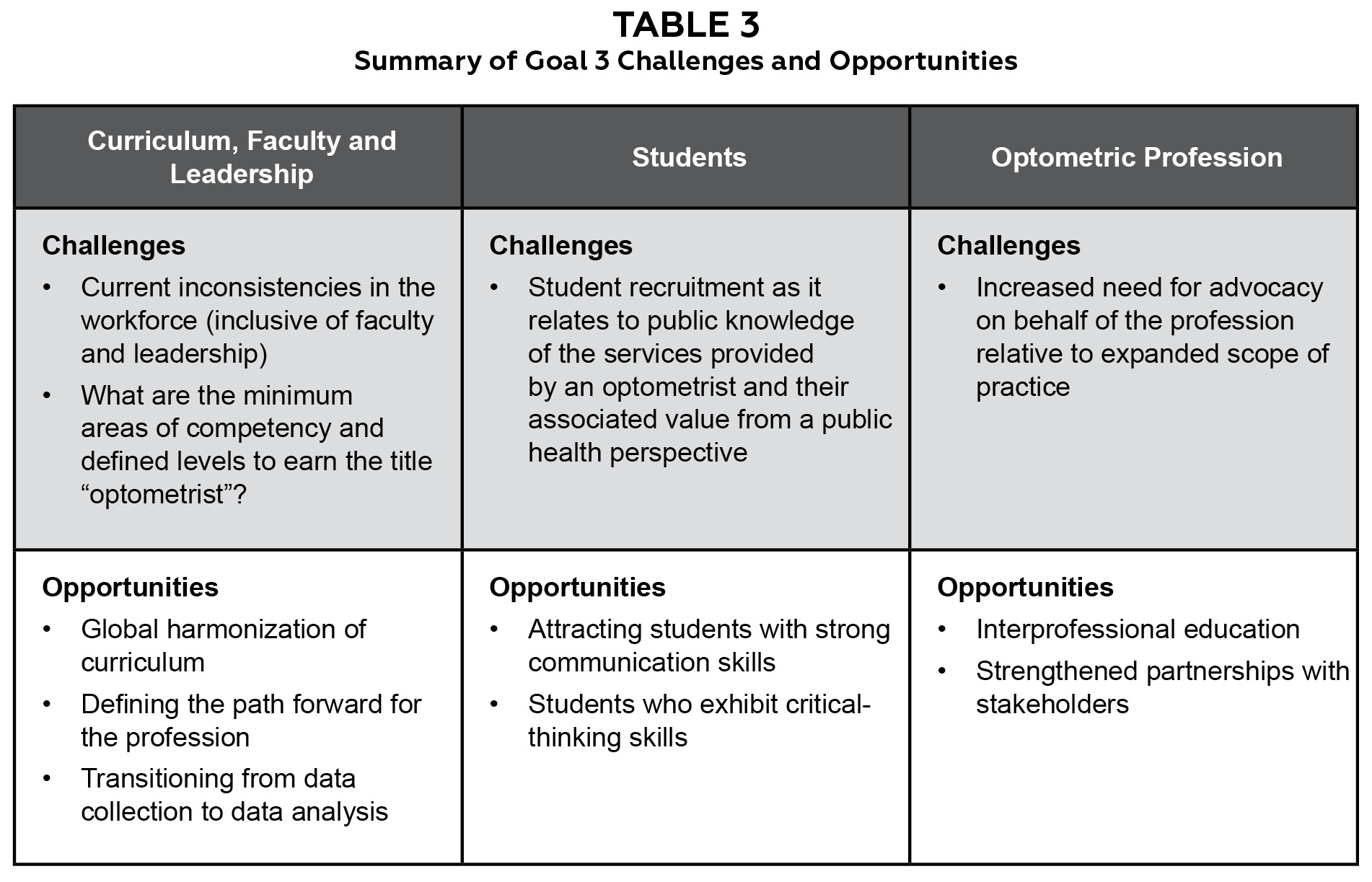
Table 3. Click to enlarge
Transitioning optometric education from data collection to data analysis was considered a laudable goal and discussed at length. It was also mentioned that students need to understand all that is involved in data collection to truly understand good data vs. bad data. While higher-order thinking should be the emphasis, students must also be educated, as in the basic sciences, about how data is collected and what can go wrong in the process. By harmonizing curricula globally, there is a greater opportunity for cultural sensitivity and more alignment in what it means to be an optometrist around the world. Global harmonization also offers the opportunity to create the caring practitioner presented as an opportunity in Goal 2. With optometrists around the world working together, discussions that clarify the future path for the profession can take place.
Students
Opportunities connected to Goal 3 in recruiting the best students were identified as:
- Attracting students with strong communication skills
- Students who exhibit critical-thinking skills
An opportunity exists to recruit students with strong communication and critical-thinking skills to better participate in patient care. The goal is to recruit a student population that could analyze data and effectively inform patients, thus providing more humane care. Along with the strong communication skills there would be an emphasis on cultural competency to be respectful of the individual patient. This discussion ties into the opportunity for faculty and leadership in Goal 3, as well as the opportunity for students presented in Goal 2. The desire is to create a caring practitioner who doesn’t see only a pair of eyes, but realizes the patient is a person and is part of a family and a larger community.
Optometric profession
The following profession-wide opportunities associated with Goal 3 were identified by each table:
- interprofessional education
- strengthened partnerships with stakeholders
Integrating optometry more fully into the healthcare systems in each country was every group’s goal. This would offer opportunities for team-based integrated patient care and open the door for interprofessional education for students. This can be assisted by strengthening partnerships with education, industry, other healthcare providers and governmental and professional organizations. As education produces the next generation of optometrists, it needs to be linked to all stakeholders to better address the future.
Discussion
In summary, action plans generated during the summit fell broadly into four areas: linking education to the scope of practice; keeping education on pace with evolving technology and information; recruiting students who will succeed and thrive in the profession; and forging strong partnerships and interactions with all parts of the eyecare community.
There was an interest in an ongoing evaluation and adjustment of the definition of optometry linked to the scope of practice and the competencies required and demonstrated. Summit participants felt that a competency-based curricula offering a skill-based, tiered approach to training would complement broader goals. Student assessment techniques would be further aligned with course levels, the learning activities and intended learning outcomes. A global body could establish benchmarks comparing optometric practice around the world and other healthcare professions. Such a body could also consider the role of online education and a possible route to accrediting that format.
There was a desire to increase the use of technology to strengthen professional/continuing education offerings and refresh and/or retrain practitioners in the field. There was an interest in applying technology to create quality patient care simulations that could replace or supplement some of the direct patient care requirements. This would require some innovation but could enhance student engagement and facilitate the transition from data collection in education to data analysis in patient care. This could possibly reduce some of the cost associated with procuring equipment for educational institutions and students as well. A strong interest was expressed in engaging retired faculty and practitioners as mentors and advisors to institutions with specific needs.
Looking to the future, it was acknowledged that the students of today are the profession of tomorrow. It is important to recruit students with skills sets that match the evolving needs of the profession. Students need to be educated and inspired to be lifelong learners and stay current with evolving evidence-based practices. They need to respect other cultures and be culturally competent as students to become culturally humble faculty, administrators and academic leaders.
Educators wanted to strengthen and broaden partnerships with optometric organizations, such as ASCO and the WCO, but also hoped to further engage industry to support shared initiatives involving faculty and leadership development. It was felt that this would help solidify optometry’s role in interprofessional collaborative care and healthcare systems while also further engaging the public and affording them a better appreciation of the profession and the healthcare services it provides. This would also advance efforts to align legislation and education, which would advance the scope of practice and population health.
Conclusion
Many of the issues facing optometric education are shared by institutions around the world and are not unique to one region. Using shared efforts and resources, innovative models can confront challenges the summit discussions identified. Increased collaborative efforts to address those challenges will allow for effective implementation of the synergistic solutions that were identified. This will facilitate a unified approach to the advancement of the profession of optometry with the ultimate goal of improved patient outcomes.
References
- Hofstetter HW. Transactions of the First World Conference on Optometric Education. London: International Optometric and Optical League, 1992.
- Oduntan OA, Mashige KP, Kio FE, Boadi-Kusi SB. Optometric education in Africa: historical perspectives and challenges. Optom Vis Sci. 2014 Mar;91(3):359-65.
- Penisten DK and Hasselmark B. Optometry and optometric education in Africa past, present, and future. South African Optometrist. 1992;51:161-71.
- Sheni DD. The evolution of optometric education and practice in Africa. South African Optometrist. 1998;57:38-41.
- Ogbuehi P. The development of optometric training in Nigeria. South African Optometrist. 1993;52:54-5.
- Sheni DD. The training of optometrists in West Africa. South African Optometrist. 1993;52:61-3.
- Ferreira JT. The development and practice of optometry in West Africa. South African Optometrist. 1993;52:56-60.
- Oduntan AO. Thirty years of optometric education at Turfloop (1975-2005): a historical and educational overview. African Vision and Eye Health. 2006;65(1):34-40.
- Mashige KP. Optometric education at Westville: past, present and future. South African Optometrist. 2010;69(1):14-20.
- Randall JW, Kumah DB. The emergence of university optometric education in Ghana. Optometric Education. 2004 Spring/Summer;29(3):80-84.
- Ovenseri-Ogbomo GO, Kio FE, Morny EK, Amedo AO, Oriowo OM. Two decades of optometric education in Ghana: update and recent developments. African Vision and Eye Health. 2011;70(3):136-41.
- Carlson AS. Optometry in Ethiopia. South African Optometrist. 2008;67(1):42-4.
- Kiely PM, Chappell R. A global competency-based model of scope and practice in optometry [Internet]. St. Louis, MO: World Council of Optometry (US);2015, 73 p. [cited 2022 Apr 26]. Available from: https://worldcouncilofoptometry.info/wp-content/uploads/2017/03/wco_global_competency_model_2015.pdf#:~:text=In%202005%2C%20the%20General%20Delegates%20Meeting%20of%20the,greater%20harmonisation%20of%20optometric%20education%20around%20the%20world.
- Woo GC, Woo SY. The need for full scope primary eye care in every country. Clin Exp Optom. 2013 Jan;96(1):1-3.