PEER REVIEWED
Training Eyecare Workers Globally: Contributions from the University of Montreal
Benoit Tousignant, OD
Abstract
Optometric education institutions play an important part to reduce avoidable blindness and visual impairment globally. Training eyecare workers in low- and middle- income countries is one way to achieve this goal. The objective of this article is to describe how the University of Montreal School of Optometry contributes to this, through its unique residency program in community eye care. It contains an international rotation, where residents train student optometrists or eye care workers in blindness prevention programs. The residents’ high level clinical training, public health coursework and experience in remote settings contribute to sustainable efforts to increase the global eyecare workforce.
Keywords
Background
Over 2.2 billion people worldwide are affected by visual impairment or blindness, often caused by treatable conditions such as uncorrected refractive error or cataracts. These significant public health issues pose a substantial burden on individuals, communities and health systems, predominantly in low- or middle-income countries.1 To reduce this burden, training human resources in eye health is a priority and aligns with strategies from major global health organizations such as the World Health Organization (WHO) and the International Agency for the Prevention of Blindness (IAPB).1-3
In order to increase the number of eyecare workers in low-resource settings, professionals from higher-income countries can play an important role in supporting higher education institutions or by training and upskilling existing staff in community-based programs.4,5 Examples of such collaborations have been reported between Wales and Ghana,6 Scotland and Malawi,7 New Zealand and Pacific Island Countries8 and between a consortium of North American optometry organizations and Haiti.9
Indeed, responding to global eye health needs requires optometrists who have a high level of clinical competency, but who are also experienced in practicing in various community or remote settings and cognisant of public health principles and sound global health practices. Residency programmes represent an opportunity for universities to train more practitioners who can contribute to reducing the global burden of visual impairment. Although there are medical residencies which incorporate components of global health,10,11 there is a limited number of North American optometrists with public health and global health training, having obtained either residency training. As of January 2025, there were 10 postgraduate residency programs with a focus on “Community Eye Care” listed in the residency directory of the Association of Schools and Colleges of Optometry (ASCO).12 All but one have their focus on domestic community eye care, tending to vulnerable urban populations in the US, without international components nor formal public health training. The other program is presented here.
In 2019, the University of Montreal’s School of Optometry (ÉOUM) started a residency program in community eye health, which incorporates clinical training in various community settings locally, as well as public health course work and an international rotation in a low- or middle-income country. The objective of this work is to describe this residency program’s components, with emphasis on its international rotation and related outcomes, through examples in Vietnam, Colombia and Senegal.
ÉOUM’s residency in community eye health
The residency program in community eye health at ÉOUM aims to develop competencies for graduate optometrists in many aspects of local and global eye health. This 1-year program includes 30 credits of specialized clinical training in community eye care (urban outreach clinics for persons experiencing homelessness13, 1-week clinical rotations in remote Indigenous communities, school screenings in urban and remote areas, Indigenous hospital-based eye care, special needs patient clinics). Residents also regularly serve as clinical preceptors for third- and fourth-year students in ÉOUM’s primary eyecare clinic. The program includes nine credits of public health courses, combining resources from ÉOUM as well as from the University of Montreal’s School of Public Health (ESPUM). Topics include general public health courses as well as local and global eyecare issues. Optionally, these course credits may subsequently be transferred towards a Master’s in Public Health program.
In addition, the residency program includes an international rotation, sending residents to a low- or middle-income country (LMIC) for a period of 1 to 3 months. The rotation usually takes place during the second half of the academic year, after the course work is completed and residents have accumulated some experience in different community settings. The rotation is organized to support local initiatives which are already in place to fight avoidable blindness and visual impairment, framed within each country’s national strategies. This often includes training eyecare workers. Partner organizations may include local universities or non-governmental organizations (NGOs) who work towards the same goals.
The international rotation was designed to have immediate, medium-term and long-term outcomes. In the short term, for the partner country, the rotation supports and helps to improve education programs and initiatives in eye care. For the resident, the rotation provides the exposure and experience of a low-resource clinical setting, where prevalence of certain conditions may be higher than in their home environment. It also exposes the resident to different academic or community settings and increases their experience in preclinical and clinical teaching in a cross-cultural, low-resource setting.
Some of the medium-term outcomes of the placement include the enrichment of the training offered in foreign institutions and organization training eyecare professionals, by exposing students to residents trained to the highest level (category 4) of the World Council of Optometry’s (WCO) competency framework,14 which includes ocular therapeutic services. Furthermore, the rotation helps increase the number of optometrists interested and experienced in community and global eye care. It also helps foster networks for ensuing collaborations after the residents’ graduation. Indeed, many past residents continue to be involved with institutions or organizations in low resource settings, taking up positions on the administrative board of NGOs, serving as guest lecturers for continuing education in LMICs, or returning for additional work stays in education or lecturing. Lastly, the residency increases the visibility of funding partners.
The main long-term outcome of the international rotation is to contribute to the elimination of avoidable blindness in developing countries, in line with the principles of sustainable development and public health. Indeed, the training of human resources in eye health and the establishment of international inter-institutional linkages are in line with the priorities of global strategies to reduce the burden of avoidable visual impairment.
The financial requirements of international rotations mainly include airfare and transportation, local room and board and afferent expenses such as travel health insurance and medical expenses (immunizations, etc.). To cover these, residents have obtained WCO grants supported by the World Optometry Foundation (formerly WCO Fellowships)15. Additional support is available from the University of Montreal’s international student mobility grants and in some cases, partner NGOs have also contributed to these expenses or to the resident’s stipend.
In the months prior to their rotation, residents undergo a pre-departure training, which covers background information on the host country (geography, society, demographics, culture) as well as cross-cultural sensitivity and travel health and safety.
Examples of past international rotations
Vietnam (Hanoi Medical University, Hanoi)
In early 2020, a resident was sent to Hanoi, Vietnam, to teach in Hanoi Medical University’s (HMU) bachelor of optometry program. HMU’s bachelor of optometry program is a 4-year program, with cohorts of up to 60 students per year. The program trains optometrists to practice independent primary eye care, including the use of diagnostic agents. That program had been developed since 2010 in collaboration with the Brien Holden Vision Institute (BHVI). A three-way collaboration between HMU, BHVI and ÉOUM allowed for this first placement to take place.
Although initially planned to last 15 weeks, this rotation lasted from January to mid-March of 2020, after being interrupted by the COVID-19 pandemic. Nevertheless, during this time, the resident was successfully involved in many aspects of education and clinical care.
She taught in some preclinical labs for third-years, as well as expanded the hours of “open labs” where students could come and practice clinical diagnostic procedures and develop their clinical thinking on one another, under her supervision. The resident also mentored some of the local teaching assistants, who had recently graduated from the program.
In addition to precepting fourth-year students in primary care clinic, improving their technical skills and their efficiency during comprehensive eye exams, she also contributed to improving some aspects of operations management and record keeping in one of the clinical sites. The rotation included clinic days in ophthalmology departments in various hospitals, experiencing the professional collaborations between optometry and ophthalmology in Vietnam to manage cases of advanced cataracts, diabetic retinal disease and ocular traumas. In all, over the 6-week period, she was exposed to over 150 patient encounters and contributed to 70 hours of teaching.
The resident was also invited to partake in one of the regular meetings of eyecare NGOs involved in Vietnam. This roundtable of various stakeholders allowed her to get some “real-life” insight on how organizations can try to align their actions as part of a national strategy for the prevention and elimination of avoidable blindness.
Colombia (Fundación Universitaria del Área Andina, Pereira)
From January to March 2022, a resident was sent to Colombia, at the University of Areandina (Fundación Universitaria del Área Andina, FUA) in Pereira, Colombia. This institution has a 10-semester, full-time bachelor program training optometrists, fully accredited by Colombia’s Department of Education. Optometrists in Colombia are competent in providing primary eye care with the use of diagnostic agents.
During her 13-week stay, the resident was involved in teaching over 150 students. Her duties included preclinic training of third-year students in binocular vision and pediatrics, contact lenses and evaluating clinical case presentations. She also precepted fourth-year students in outreach activities, which included comprehensive examinations in community organizations for persons experiencing homelessness or domestic violence.
Furthermore, she was involved in precepting fourth- and fifth-year students in primary care clinic, specialty contact lenses, vision therapy and binocular vision clinics. Her interventions were helpful to increase students’ efficiency and she reinforced their diagnostic skills such as Goldmann tonometry and fundus examinations (fundus biomicroscopy and binocular indirect ophthalmoscopy). She gave presentations on glaucoma diagnosis and management, to increase the capacity of future Colombian optometrists to understand this condition, even though their scope of practice does not currently include the treatment of glaucoma.
She was exposed to many cases of diabetic eye disease, hypertensive retinopathy and parasitic ocular infections. The refraction technology present in the local clinical installations did not always include phoropters or LCD screens, which increased her experience with retinoscopy and trial lens refraction. Because of her North American training, her input was sought by FUA’s administration when it considered purchasing higher technology diagnostic instruments. Finally, she was invited to teach nursing students about the role of primary care optometrists in the comprehensive care of patients. Over the course of her 3-month rotation, the resident was exposed to over 250 patient encounters and provided over 85 hours of teaching or precepting.
In the year following her residency graduation, the resident was an invited speaker at a regional South American conference in optometry and has since returned to FUA Pereira for an additional teaching rotation as a guest lecturer.
Senegal (Association saint-louisienne pour la vue, Saint-Louis)
In January 2023, two residents were sent to Senegal for a 1-month rotation. This placement aimed to support a local, community-based blindness prevention program. Since 2019, the Programme de Prévention et de Lutte contre la Cécité (PPLC) in Saint-Louis, Senegal, is a collaboration between the Association Saint-Louisienne pour la Vue (ASV) and Iris Mundial, an NGO from Montreal. Under the supervision of a local ophthalmologist, who heads ASV, the PPLC offers vision screening services at the Diougop Community Eye Center, outreach mobile clinics and school screenings in the Saint-Louis region, the second largest city in Senegal. Program staff includes nurses, opticians and a Technicien supérieur d’ophtalmologie (TSO), a mid-level eye cadre who provides primary eye care including refraction and ocular health assessments. Iris Mundial contributes to the training and upskilling of the eyecare workers involved in the PPLC as well as technical and equipment support.
The residents’ placement had various objectives relating to staff training and upskilling as well as monitoring and evaluation of the PPLC. Their rotation was the first in-person support trip since the COVID-19 pandemic, during which most program assistance had been through distance, virtual training sessions. During their stay, the residents assisted the nurses in vision screenings, both at the clinic and in outreach clinics. They also provided the staff with training on skills such as phoropter-based refraction and tonometry.
The residents were exposed to many cases of glaucoma, advanced cataracts and other ocular pathologies during clinics with ophthalmology. They took part in school screenings, providing insight to improve screening protocols and operations management to increase sensitivity and specificity. The residents also reviewed the program’s tools and methods used for eye health promotion during the PPLC activities. They also provided training of the optician and operations management improvements for the PPLC’s optical component. Among other program evaluation components, the residents also assessed the organization and output of the program staff and provided recommendations for future training, as well as acquisition and maintenance of medical technology and consumables. In all, over 1 month, the residents were each exposed to over 150 patient encounters and jointly provided over 50 hours of training and mentoring for local eye health personnel.
The residency program – past and future
From its inception in 2019 and until 2023, five residents were trained in this new program. At the time of writing, one or two residents will be following the program during the 2025-26 year. One 2023 graduate transferred into the Master in Public Health Program, to be completed in 2025.
Plans are underway for the former residents, alongside future residents, to return to Senegal in January 2026 for follow-up work relating to PPLC’s monitoring and evaluation. Possibilities for future residents to return to Vietnam or Colombia are also being discussed, the latter being dependent on residents’ level of ease in Spanish.
Although not required in Canada, application for the accreditation of the program by the ACOE is being considered for the near future.
Conclusion
As the global health community is deploying efforts to eliminate avoidable blindness and visual impairment, optometry institutions have their part to play in training eyecare workers in low- and middle- income countries, a strategy put forward by the WHO and the IAPB. The University of Montreal School of optometry contributes to this with its residency in community eyecare program, which sends out graduate optometrists to low resource settings. With their specific skill set comprised of high-level clinical training, public health course work and experience in various community-based clinical settings, they add to the group of optometrists who can contribute to quality local eyecare training and sustainable avoidable blindness programs.
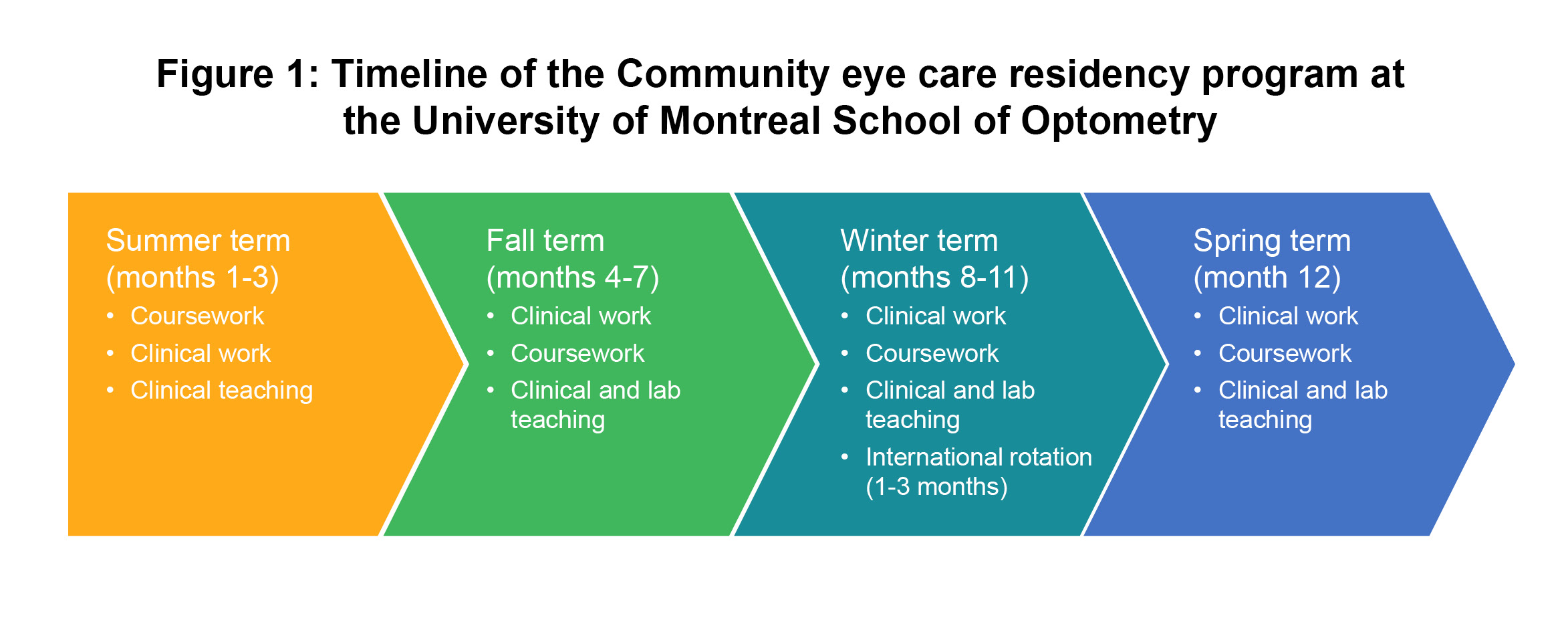
Figure 1. Click to enlarge
References
- Global strategy on human resources for health: workforce 2030 [Internet]. Geneva, Switzerland: World Health Organization c2020 [cited 16 Jan 2024]. Available from: https://www.who.int/publications/i/item/9789241511131
- Sousa A, Scheffler RM, Nyoni J, Boerma T. A comprehensive health labour market framework for universal health coverage. Bull World Health Organ. 2013 Nov 1;91(11):892-894. DOI:10.2471/BLT.13.118927
- Core competencies for the eye health workforce in the WHO African Region [Internet]. Brazzaville: WHO Regional Office for Africa; c2019. Available from: https://www.afro.who.int/publications/core-competencies-eye-health-workforce-who-african-region
- Du Toit R, Brian G. Mid-level cadre providing eye care in the context of Vision 2020. N Z Med J. 2009;(122):77-88.
- Palmer JJ, Chinanayi F, Gilbert A, et al. Mapping human resources for eye health in 21 countries of sub-Saharan Africa: current progress towards VISION 2020. Hum Resour Health. 2014 Aug 15;12:44-44. DOI:10.1186/1478-4491-12-44
- Young K. Ghana-Wales Vision Pact: celebrating optometry through collaboration [Internet]. London, UK: Optometry Today; c2024 [cited 2025 January 27]. Available from: https://www.aop.org.uk/ot/life-in-practice/practitioner-stories/2024/03/27/ghana-wales-vision-pact-celebrating-optometry-through-collaboration
- DR-NET in action – Malawi [Internet]. London, UK: International Center for Eye Health; c2019 [cited 2025 Jan 27]. Available from: https://iceh.lshtm.ac.uk/dr-net-in-malawi/
- Du Toit R, Brian G, Palagyi A, Williams C, Ramke J. Education of eye health professionals to meet the needs of the Pacific. N Z Med J. 2009 Mar 13;122(1291):69-76.
- Optometry students in Haiti receive invaluable hands-on training, despite civil unrest [Internet]. Golden, CO: Optometry Giving Sight; c2021 [cited 2025 Jan 27]. Available from: https://givingsight.org/news/students-in-haiti-receive-training/
- Hau DK, Smart LR, DiPace JI, Peck RN. Global health training among US residency specialties: a systematic literature review. Med Educ Online. 2017;22(1):1270020. DOI:10.1080/10872981.2016.1270020
- Kaeppler C, Holmberg P, Tam RP, et al. The impact of global health opportunities on residency selection. BMC Med Educ. 2021 Jul 15;21(1):384. DOI:10.1186/s12909-021-02795-5
- Optometry Program Residency Search [Internet]. Rockville, MD: Association of Schools and Colleges of Optometry; [cited 2025 Jan 24]. Available from: https://myasco.opted.org/searchEngines/residency_advanced_search_form.aspx
- Tousignant B. Eye care for the homeless: first year of data from a mobile teaching clinic [Internet]. San Antonio, TX: American Academy of Optometry; c2018. Available from: https://umontreal.scholaris.ca/items/825040e5-7881-4544-94cf-e383e318e771
- A Global Competency-Based Model of Scope of Practice in Optometry [Internet]. St Louis, MO: World Council of Optometry; c2017 [cited 2025 Jan27]. Available from: https://worldcouncilofoptometry.info/wp-content/uploads/2017/03/wco_global_competency_model_2015.pdf
- About the WCO Grant Program [Internet]. St Louis, MO: World Council of Optometry c2024; [cited 2024 Jan 30]. Available from: https://worldcouncilofoptometry.info/about-the-wco-grant-program/