PEER REVIEWED
Interprofessional Education and Collaborative Practice at Schools and Colleges of Optometry: An Update
Jasmine Wong Yumori, OD, FAAO, Dipl AAO, FNAP, Melissa Zarn Urankar, OD, FAAO, FNAP, Linda Casser, OD, FAAO, FNAP, Julie A. Tyler, OD, FAAO, FNAP, Amy Logan, OD, FAAO, Tracy Wang, OD
Interprofessional education and collaborative practice (IPECP) improve healthcare quality and safety and are important components of optometric education. In August 2020, the 25 member institutions and associate members of the Association of Schools and Colleges of Optometry were surveyed to increase understanding of their IPECP efforts. The 2020 survey results indicated that implementation trends had stabilized, and IPECP was becoming increasingly important, consistent with earlier survey findings. Barriers to development and integration – including lack of time, interest, funding and scheduling difficulties – continue to persist. Additional resources are needed to support further growth and development.
Keywords
Background
According to the World Health Organization, interprofessional education (IPE) “occurs when students from two or more professions learn about, from and with each other to enable effective collaboration and improve health outcomes.”1 Interprofessional collaboration (IPC) is “the process in which different professional groups work together to positively impact health care.”2 Interprofessional education and interprofessional collaboration, together termed interprofessional education and collaborative practice (IPECP), are important components of health education. According to the original 2011 Interprofessional Education Collaborative (IPEC) panel, which created the first Core Competencies for Interprofessional Collaborative Practice, “in order to deliver high-quality, safe and efficient care, and meet the public’s increasingly complex health care needs, the educational experience must shift from one in which health profession students are educated in silos to one that fosters collaboration, communication, and a team approach to providing care.”3 The revised report “Attributes of Students Graduating from Schools and Colleges of Optometry”4 was released in the same year by the Association of Schools and Colleges of Optometry (ASCO) and outlined the following attributes as critical to recipients of the Doctor of Optometry Degree:
- Have the ability to appropriately use all resources, including the use of ancillary personnel, intra- and interprofessional collaboration, co-management, and referral, in ensuring the best quality patient care
- Manage their practices in a manner that is appropriate within the healthcare delivery system and that promotes patient access to eye and vision care
- Have the ability to recognize personal limitations regarding optimal patient care and to work with the broader health care community in providing the best care possible
- Have a commitment to work as an integral member of the larger interprofessional health care team to improve patient care outcomes
- Have the ability to recognize and initiate the coordination of patient care requiring advanced medical, systemic, interprofessional, or specialty care
- Have the ability to work in cooperation with those who receive care, those who provide care, and others who contribute to or support the delivery of prevention and health services
In 2011, ASCO also developed a survey to identify IPECP activities; this survey was subsequently disseminated in 2013 and 2015, with a special report published in 2015 revealing that 19 out of the 21 schools and colleges of optometry that took part in the ASCO survey participated in IPE activities, with nine indicating that IPE was a program requirement, eight describing “IPE coursework involving students from different programs teaching one another,” and 20 various professions represented in IPE activities across all schools and colleges of optometry.5 Given the shared values between ASCO and IPEC, ASCO became the first IPEC Supporting Organization6 and was represented in the 2016 update of the IPEC Core Competencies for Interprofessional Collaborative Practice.7 It is important to note that the term “Interprofessional Practice” (IPP) is often used interchangeably with “Interprofessional Collaboration” (IPC) and is included in the IPECP acronym.
In 2016, ASCO’s Interprofessional Education and Collaborative Practice (IPECP) Committee brought together members from schools and colleges of optometry as well as representatives from non-optometry health professions institutions and organizations to “identify and share current best practices and ideas on future development of IPE and IPP”8 at an in-person IPECP Summit. Future trends and implementation plans were also established9 and resources were subsequently collaboratively created, including a video featuring educators and students sharing the importance of IPECP in optometric education and how it improved patient outcomes,1,2 a Special Interest Group (SIG) to facilitate the exchange of ideas between faculty and administrators at the schools and colleges of optometry,3,11 an IPECP Toolkit to “serve as a guide for building, implementing and sustaining IPECP initiatives at optometric institutions.”12 The ASCO Board more recently adopted the IPECP Core Competencies for Optometric Education (Table 1).13
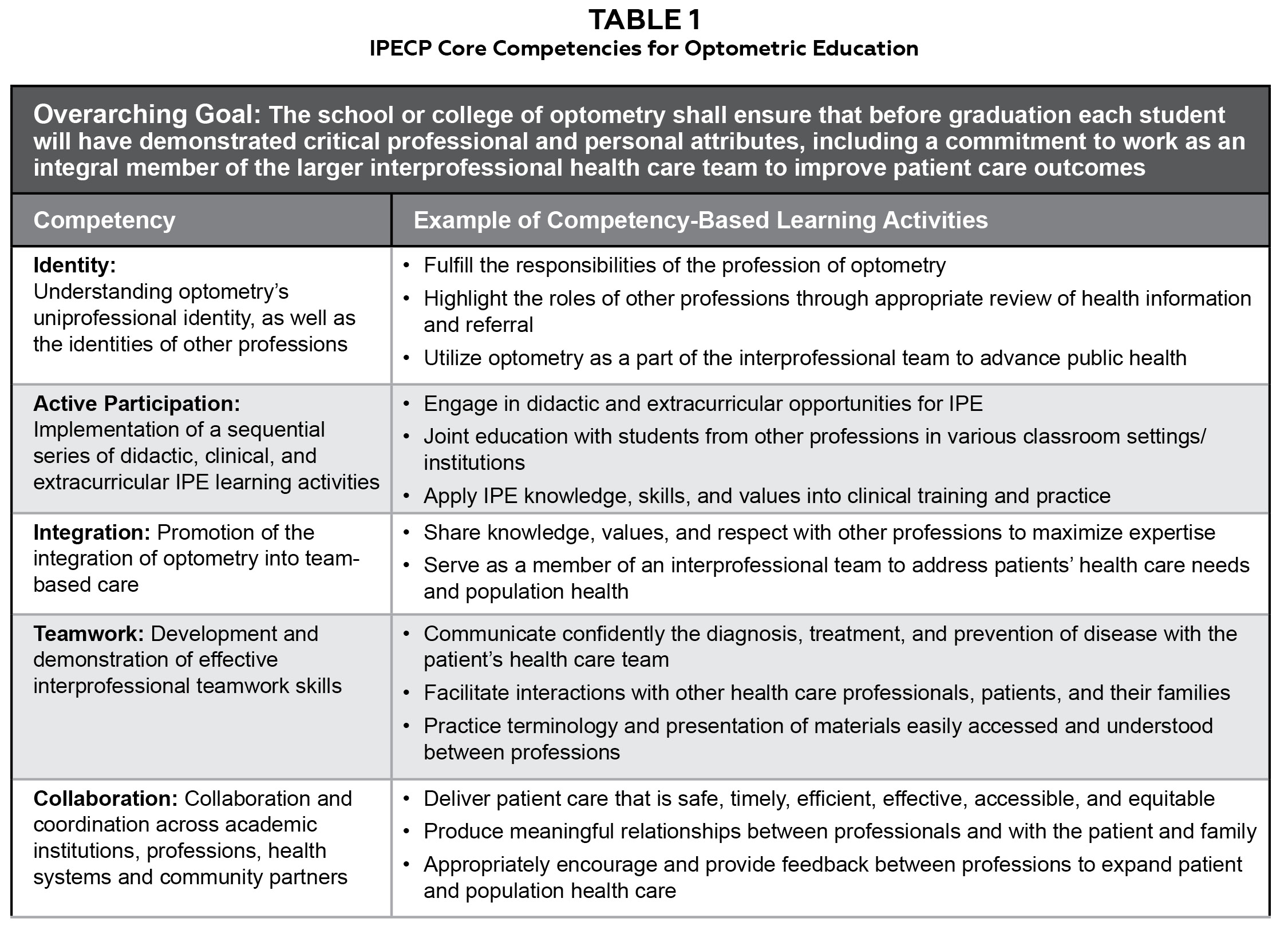
Table 1. IPECP Core Competencies for Optometric Education. Click to enlarge
Given the increased focus on IPECP both within and beyond optometry, ASCO’s IPECP Committee and SIG share in this article updates from ASCO’s 2020 survey regarding current IPECP activities at ASCO member and associate member schools and colleges of optometry.
Methods
The 16-question survey, originally developed in 2011 by an ASCO Government Affairs staff member5 and subsequently updated by ASCO’s Interprofessional Education and Collaborative Practice (IPECP) Committee and SIG and disseminated in 2013 and 2015, was updated and provided via SurveyMonkey to each president and chief academic officer at the 25 ASCO member schools (23 regular, two associate) in August 2020 with a deadline to respond by October 2020. The survey consisted of four sections: Participation, Infrastructure and Barriers, Programming, and Resources. Survey items can be found in the Appendix. While reminders were provided, no incentives were offered for survey completion. Data analysis utilized mainly descriptive statistics; open-ended survey item responses were also reviewed by the Committee. The Institutional Review Board at Western University of Health Sciences approved this study as exempt research.
Results
Representatives from 23 member schools (22 regular and one associate) completed and returned the surveys, resulting in a response rate of 92%. Of the 23 schools that responded to the survey, 17 (73.91%) reported that their program requires participation in IPECP for all optometry students, with 22 (95.65%) schools reporting optometry faculty participation in IPECP activities and eight (36.36%) indicating that participation by optometry faculty was required.
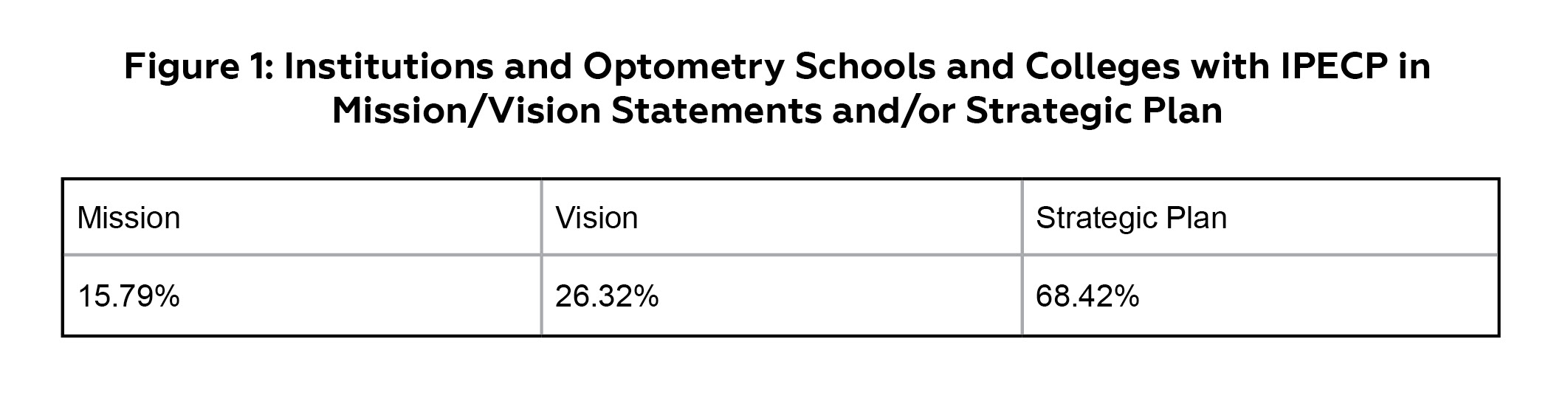
Figure 1. Institutions and Optometry Schools and Colleges with IPECP in Mission/Vision Statements and/or Strategic Plan. Click to enlarge
When asked whether the ASCO school/college and/or associated institution has IPECP in their mission and/or vision statements and/or strategic plan, 19 responses were received. While the response rate for the overall survey was 23, the response rate for this specific question was 19. The number of respondents will be used as the denominator for percentage calculation where applicable for this question. Thirteen (68.42% of 19 responses) schools reported inclusion in their optometry strategic plans, five (26.32% of 19 responses) schools in their optometry vision statements, and three (15.79% of 19 responses) schools in their optometry mission statements. Results from this item are summarized as percentages in Figure 1. While the difference between institution and school may be thought of as institution referring to larger, if appropriate, organization and school referring to school or college of optometry, no definitions were provided in the survey.
The top five professions with which optometry schools reported collaborating were Medicine (MD/DO) (91%), Nursing (87%), Pharmacy (83%), Occupational Therapy (61%), and Social Work (57%). Table 2 lists all the collaborating professions reported by survey respondents reported from the 2011, 2013, 2015 and 2020 surveys, with more than 33 collaborating professions across all programs in 2020. Examples of reported IPECP experiences include clinical shadowing, outreach, collaborative care planning, workshops, lectures, screenings, case discussions and simulations.
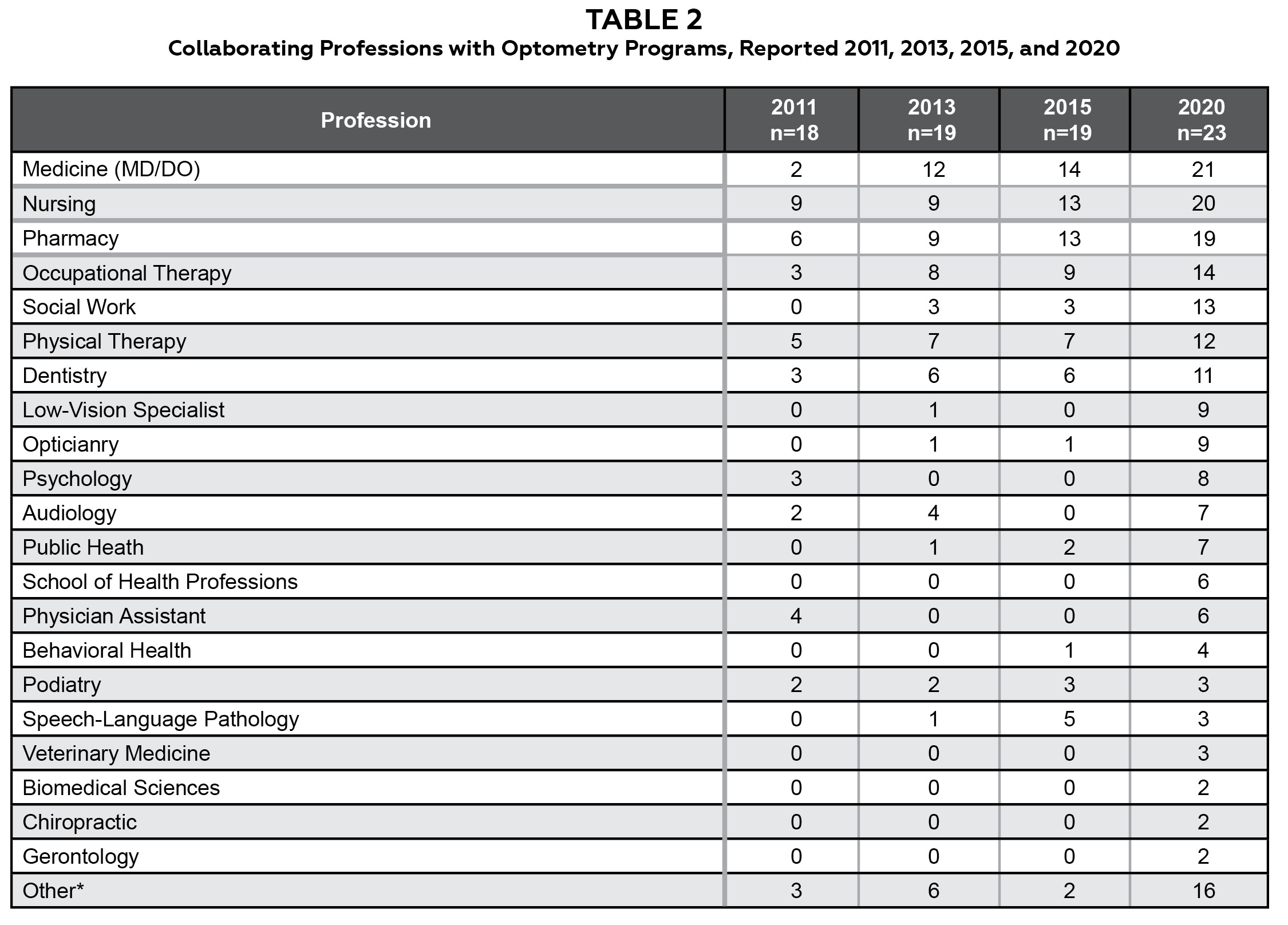
Table 2. Collaborating Professions with Optometry Programs, Reported 2011, 2013, 2015, and 2020. *Other collaborating professions included Acupuncture, Athletic Training, Cardiovascular Perfusion, Dental Hygiene, Law, Medical Laboratory Technology, Nutrition Science, Recreation Therapy, Respiratory Therapy, Sonography Click to enlarge
Relating to interprofessional programming, variations existed in terms of formal versus informal activities or interactions, with eight programs (34.78%) reporting mainly formal (includes required courses and assignments), 12 programs (52.18%) reporting mainly informal (includes interactions not specific to assigned courses), and three programs (13.04%) reporting equal amounts of formal and informal. Similar variations were seen with scheduling, with 10 programs (43.48%) reporting mainly synchronous (scheduled/pre-set meeting times), eight programs (34.78%) reporting mainly asynchronous (programs/assignments completed within a specified timeframe), and two (8.70%) reporting equal amounts of synchronous and asynchronous IPECP activities or interactions. Examples of IPECP opportunities included case discussion, community outreach and within clinical settings.
Knowledge associated with the IPEC Core Competencies were included in most curricula. The most common means of inclusion reported was optometry-only courses (15 programs, 65.22%). IPEC Core Competencies were also reported to be included in interprofessional/collaborative courses (11 programs, 47.83%), interprofessional special projects (11 programs, 47.83%), and multi-disciplinary courses (three, 13.04%). Regarding National Board of Examiners in Optometry (NBEO) topics being taught at least partially within interprofessional coursework, the most common topic covered was Communication Skills (nine programs, 39.13%). Other topics covered included: Legal Issues/Ethics/Public Health (eight programs, 34.78%), Diagnosis (seven programs, 30.43%), Treatment/Management (seven programs, 30.43%), Clinical Presentation (six programs, 26.09%), Clinical Correlation of Basic Science Principles (six programs, 26.09%), Affective Skills (six programs, 26.09%), and Clinical Observation and Reporting Skills (six programs, 26.09%).
Regarding assessing outcomes of interprofessional activities and courses, 16 (69.57%) reported course-related tests, student reflections, or similar, 11 (47.83%) reported use of validated survey instruments, 11 (47.83%) reported informal surveys, four (17.39%) reported student focus groups, and six (26.09%) reported no formal assessment.
When asked about institutional infrastructure, six (26.09%) reported having a formally appointed standing committee with interprofessional representation, five (21.74%) reported no formal structure with significant numbers of IPECP activities offered by individual IPECP champions, four (17.39%) reported having a centralized administrative structure with dedicated personnel and office space to lead IPECP at an institutional level, three (13.04%) reported either having an ad hoc task force, and another five (21.74%) reported no formal structure with few IPE activities, courses, and/or designated experiential rotations.
When asked whether IPECP is referenced in promotion and tenure guidelines for faculty, 17 (73.91%) reported no reference, four (17.39%) reported reference within optometry guidelines, two (8.70%) reported reference within institutional guidelines, and two (8.70%) reported other.
When asked about the full time equivalent (FTE) assignment of the leader designated exclusively to IPECP responsibilities, seven (30.43%) reported no designated IPECP leader, 12 (52.17%) reported 0-25%, one (4.35%) reported 26-50%, none reported 51-75%, and three (13.04%) reported 76-100%.
Regarding how IPECP is financed, nine (39.13%) reported centralized funding managed by central administration, seven (30.43%) reported no dedicated budget, and six (26.09%) reported that each college/program funds their own projects.
The largest unaddressed barriers to IPECP implementation and growth were reported as lack of time (11), lack of interest by other programs (10), scheduling difficulties (10), lack of interest by optometry faculty (eight), and lack of funding (seven). The survey question asked respondents to select “does not exist,” “addressed,” or “not addressed” for each barrier. The results reported focus on the count of schools responding “not addressed” indicating where the barriers continue to impede IPECP. For example, for lack of time, 11 schools reported it was “not addressed,” while the remaining 12 schools either reported that the barrier was “addressed” or “does not exist.”
When asked about resources for faculty and program development (for example, whether representatives from their institution attended any IPEC-sponsored workshops), 17 (73.91%) responded yes while six programs (26.09%) responded no. Interest in the development of a “universal” IPECP initiative that could be implemented by all schools and colleges of optometry was affirmed by 15 respondents (65.22%) and the remaining eight (34.78%) said no; however, 21 (91.30%) respondents recommended that ASCO host a second IPECP Summit.
Discussion
As IPECP has become more established, implementation trends are stabilizing within optometric education and are consistent with nationwide trends across health professions programs.14 Specifically, the 2020 survey data, when viewed against the earlier 2011, 2013 and 2015 surveys, supports the finding that IPECP implementation is becoming more established. The importance of IPECP within optometric education is reflected not only in the number of optometric programs that require participation in IPE for students and include faculty involvement but also by its inclusion in the majority of ASCO schools and colleges’ strategic plans and vision statements, with many also including IPECP in their mission statements both at a school/college level and at an institutional level. The recent development of resources, including the ASCO IPECP Toolkit and Core Competencies for Optometric Education, further supports these trends.
There are large variations in interprofessional programming when it comes to types of activities and interactions, formality, timing, and assessment. There is also diversity in collaborating professions across ASCO schools and colleges, with medicine, nursing, pharmacy, occupational therapy and social work being the most common. While there is growth in the frequency of collaborations for almost all professions, some variations exist likely due to the prospect of collaborations within the clinical setting and scheduling difficulties between programs. Aligning academic calendars for collaborating professional programs and building in scheduling flexibility have been shown to be helpful.15-19 In addition to difficulties with scheduling, challenges with interest and funding persist. These barriers are seen within other health professions programs and can adversely affect the realization of IPECP.16,20,21 Challenges related to lack of physical resources and geographical barriers previously reported5 may not be as common because of the increased access to and use of technology. Opportunities for further development within optometric education include strengthening IPECP infrastructure and including IPECP within the faculty promotion process. While references to IPECP within the faculty promotion process is also not common across other health professions programs,21 it is promising that infrastructural support, such as a centralized administrative structure, designated IPECP leadership, dedicated budget, systematic planning, and internal faculty development, is seen across most health professions programs.14
One such resource that was designed to enhance the foundation for sustainable IPECP development within optometric education was the 2022-2023 IPECP virtual summit. Developed by the ASCO IEPCP Special Interest Group, the goal of the 2022-2023 IPECP virtual summit was to create a collaborative scholarly environment and to demonstrate improved patient outcomes resulting from the implementation of IPE programming.
Conclusion
While optometry and other health professions are moving beyond simply recognizing the importance of IPECP, and efforts are becoming more organized and operationalized while at the same time varied in terms of types of activities and interactions and collaborating professions, barriers to development and integration continue to persist. Refining methods to assess the quality of IPECP efforts more formally and maximizing resources to support further growth and develop are increasingly important.
Appendix
References
- Framework for Action on Interprofessional Education & Collaborative Practice [Internet]. Geneva: World Health Organization; c2010 [cited 2022 February 11]. Available from: http://apps.who.int/iris/bitstream/handle/10665/70185/WHO_HRH_HPN_10.3_eng.pdf
- Zwarenstein M, Goldman J, Reeves S. Interprofessional collaboration: effects of practice-based interventions on professional practice and healthcare outcomes. Cochrane Database Syst Rev. 2009 July 8:(3):CD000072. DOI: 10.1002/14651858.CD000072.pub2
- Interprofessional Education Collaborative. Team-Based Competencies: Building a Shared Foundation for Education and Clinical Practice [Internet]. Washington, DC: Interprofessional Education Collaborative; c2011 [cited 2026 June 25]. Available from: https://www.aamc.org/download/54338/data/culturalcomped.pdf
- Smythe J, Daum K. Attributes of Students Graduating from Schools and Colleges of Optometry: A 2011 Report from the Association of Schools and Colleges of Optometry [Internet]. Rockville, MD: Association of Schools and Colleges of Optometry; c2011 [cited 2026 June 25]. Available from: https://optometriceducation.org/files/2011_AttributesReport.pdf
- Baker JL, Vitek MA. Interprofessional Education and Collaborative Patient Care at U.S. Schools and Colleges of Optometry: A Special Report. Optometric Education. 2015 Winter/Spring;40(2):72-76. Available from: https://journal.opted.org/articles/Volume40_Number2_WinterSpring2015-SpecialReport.pdf
- Interprofessional Education Collaborative. IPEC Members [Internet]. Washington, DC: Interprofessional Education Collaborative; c2022 [cited 2022 February 12]. Available from: https://www.ipecollaborative.org/membership
- Interprofessional Education Collaborative. IPEC Core Competencies [Internet]. Washington, DC: Interprofessional Education Collaborative; c2011 [cited 2022 February 12]. Available from: https://www.ipecollaborative.org/ipec-core-competencies
- Interprofessional Education and Collaborative Practice Summit [Internet]. Rockville, MD: Association of Schools and Colleges of Optometry; c2016 [cited 2022 February 12]. Available from: https://optometriceducation.org/interprofessional-education-and-collaborative-practice/interprofessional-education-and-collaborative-practice-summit/
- Vitek M. Report from the ASCO Interprofessional Education and Collaborative Practice Summit [Internet]. Rockville, MD: Association of Schools and Colleges of Optometry; c2016 [cited 2022 February 12]. Available from: https://eye.opted.org/3154
- Interprofessional Education and Collaborative Practice Sponsored by Johnson and Johnson [Internet]. Rockville, MD: Association of Schools and Colleges of Optometry; c2019 [cited 2022 February 12]. Available from: https://optometriceducation.org/interprofessional-education-and-collaborative-practice/
- Interprofessional Education [Internet]. Rockville, MD: Association of Schools and Colleges of Optometry; c2019 [cited 2022 February 12]. Available from: https://optometriceducation.org/interprofessional-education-and-collaborative-practice/
- IPECP Toolkit: A Guide for Effective Interprofessional Education and Collaborative Practice Experiences in Optometric Education [Internet]. Rockville, MD: Association of Schools and Colleges of Optometry; c2020 [cited 2022 February 12]. Available from: https://optometriceducation.org/news-resources/ipe-toolkit/
- Interprofessional Education and Collaborative Practice (IPECP) Core Competencies for Optometric Education [Internet]. Rockville, MD: Association of Schools and Colleges of Optometry; c2022 [cited 2022 May 26]. Available from: https://optometriceducation.org/wp-content/uploads/2022/03/ASCO-IPECP-Core-Competencies-for-Optometric-Education-3-2022.pdf
- Bennie S, Blue A, Brandt B, et al. Organizational Models of Interprofessional Practice and Education in the United States: Results from a National Survey [Internet]. Minneapolis: National Center for Interprofessional Practice and Education; c2020 [cited 2022 July 18]. Available from: https://nexusipe.org/informing/resource-center/organizational-models-interprofessional-practice-and-education-united
- Palatta A, Cook BJ, Anderson EL, Valachovic RW. 20 Years Beyond the Crossroads: The Path to Interprofessional Education at U.S. Dental Schools. J Dent Educ. 2015 Aug;79(8):982-96. DOI: 10.1002/j.0022-0337.2015.79.8.tb05990.x
- Hammick M, Freeth D, Koppel I, Reeves S, Barr H. A best evidence systematic review of interprofessional education: BEME Guide no. 9. Med Teach. 2007 Oct 29;29(8):735-51. DOI: 10.1080/01421590701682576
- Mann KV, Mcfetridge-Durdle J, Martin-Misener R, et al. Interprofessional education for students of the health professions: the “Seamless Care” model. J Interprof Care. 2009 May;23(3):224-33. DOI: 10.1080/13561820802697735
- Pittenger AL. The Use of Social Networking to Improve the Quality of Interprofessional Education. Am J Pharm Educ. 2013 Oct 14;77(8):174. DOI: 10.5688/ajpe778174
- Shrader S, Griggs C. Multiple Interprofessional Education Activities Delivered Longitudinally Within a Required Clinical Assessment Course. Am J Pharm Educ. 2014 Feb 12;78(1):14. DOI: 10.5688/ajpe78114
- Rafter ME, Pesun IJ, Herren M, Linfante JC, Mina M, Wu CD, et al. A preliminary survey of interprofessional education. J Dent Educ. 2006 Apr;70(4):417-27.
- Buring SM, Bhushan A, Broeseker A, Conway S, Duncan-Hewitt W, Hansen L, et al. Interprofessional Education: Definitions, Student Competencies, and Guidelines for Implementation. Am J Pharm Educ. 2009 Jul 10;73(4):59. DOI: 10.5688/aj730459